
Modern master of the short story George Saunders found commercial and critical success with his first full-length novel, the wonderfully experimental Lincoln in the Bardo (2017). It follows Abraham Lincoln’s son, Willie, who’s trapped in the ‘bardo’, a Buddhist-inspired domain between life and rebirth, along with a vast cast of fretful spirits.
With his new novel, Vigil, Saunders returns to this (albeit slightly altered) liminal realm for an A Christmas Carol-esque tale of spectral visitations. Our narrator is the ghost – though the author makes pains to avoid the term – of Jill ‘Doll’ Blaine, a telephone operator and sometimes waitress from the American Midwest, who died in a rather unfortunate way at 22. After apparently transcending the petty concerns of her mortal life, she now exists in the bardo, driven by a singular purpose: to comfort the dying and ease their transition into the hereafter.
Her latest ‘charge’ is the uber-successful but obstinate K.J. Boone, CEO of the world’s largest oil firm and an early climate change denier. Boone gaslit the world, both literally and figuratively, spending decades commissioning bogus research and spreading misinformation about the catastrophic effects of fossil fuels to secure a profitable future for his industry.
Despite Boone’s long list of sins, when ghost-Jill hurtles down from the heavens to his Dallas mansion – where the now-octogenarian lies unresponsive in his deathbed – she senses none of the doubts and regrets that usually plague her charges in their final hours. As she ‘enters the orb of his thoughts’ (a kind of mild-meld that allows beings in the bardo to communicate directly through thoughts and memories), she finds a man consumed by smug self-assurance of his accomplishments. ‘Pigheaded,’ as one character later describes him, ‘with an astonishingly limited capacity for self-examination’.
As the Southern summer evening wears on, Boone is visited by a motley crew of characters – both real and imagined, living and dead – all seeking a sort of reckoning. Among them is the spectre of a Frenchman, obviously inspired by Étienne Lenoir, inventor of the internal combustion engine (though not acknowledged as such): a tragicomic figure whose afterlife mission is to confront those who, like him, have sinned against the natural world, and force them to face their misdeeds with ‘contrition, shame, and self-loathing’.
Jill, being a self-described ‘elevated’ entity, holds a more detached, deterministic view of Boone, insisting that he, like everyone else, could only have been exactly who he was, given the particular person he was born as and the circumstances he was thrust into. As the Frenchman urges Boone to take responsibility and repent, Jill encourages him to join her in a state of elevation by relinquishing his ‘self’ – that pesky thing to which all his pain, blame, and shame are attached. But Boone, unable to face his sins and unwilling to give up the intoxicating experience of being himself – a man who ‘called a king and a king picked up’ – resists them both, forcing the ghosts to seek ever-escalatory tactics to win his soul.
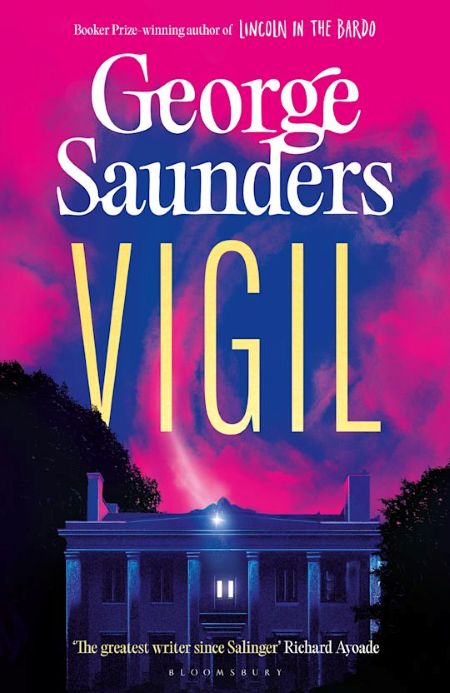
Style-wise, Vigil is vintage Saunders. The prose is lean but high-register, pared down but still retaining a maximalist vocabulary that never becomes pretentious thanks to the author’s ever-present wit and generous capacity for silliness. This new outing proves that he’s a master of the emphatic line break, whether for humorous or poignant effect, and he never fails to amuse with his lyrical compound concoctions (my favourite being “former-person-bearing meatlump” – i.e, corpse).
Vigil is told in the first person from Jill’s perspective, but the mild-meld conceit allows Saunders to focalise quite heavily through other characters. As in his short fiction, the author excels when he veers into satirically jerkish corporate speak. This time, it’s the cringingly dated business-bro lingo of Boone and his corporate cronies, who use painful, Spanglish phrases like ‘amigo’, ‘el-kiddo’, and ‘the whole enchilada’ to convey a sort of frat-dude condescension. It’s funny and nicely balanced against Jill’s more conventional, earnest voice.
However, some of the stylistic conceits that may prove effective in short fiction begin to feel gimmicky when sustained over a 172-page novel. Chief among them are the quotation marks used to indicate things remembered from the land of the living, as the spirit-formerly-known-as-Jill, prompted by the simple beauty of a wedding happening next door, begins to indulge in dangerous recollections from her previous life. For example, a memory of her husband: ‘Slight “touch of gray” on “sideburns” though “not yet thirty.”’
The dangers these recollections pose to Jill’s transcendence form one of the novel’s most poignant threads, as she tries to resist the nostalgic pull of her mortal life and remain undistracted from her benevolent purpose. Saunders fills slice-of-life memories with astutely observed sensory details that illustrate the unique yet universal pleasure/pain of being human.
That said, both Jill and Boone’s arcs are a little frustrating in their resolutions. In the latter’s case, Vigil excels at illustrating the cycle of blame and resistance that causes people like Boone to harden into ‘an impenetrable ball’ and double down on the validity, and even necessity, of their actions, as figures from his life, both living and dead, confront him with the destructive consequences of his greed and deceit.
But unlike Dickens’ Scrooge (the Christmas classic evidently serves as a massive influence for this novel), there’s no possibility of any meaningful redemption to come from Boone’s repentance, since he, in his infirm and terminal state, can no longer exert any agency on the world. Those hoping for a satisfying transformation will probably be disappointed, but others will enjoy the author’s rebellion against Dickens’ neat narrative structure.

Readers expecting a rigorous investigation into the relationship between capitalism and the climate crisis will also be unfulfilled, as Saunders keeps the scope of his inquiry firmly fixed on philosophical questions of morality and human nature, using the conceit of a world-killing industrialist to do so. At times, it feels like Boone could’ve been any flavour of dodgy dude – warmonger, neo-colonialist.
However, that isn’t to say there aren’t plenty of insightful observations on the subject. In one scene, Jill, who died in the 1970s, hovers over a motorway, considering how petrol stations have changed since her time:
‘the commerce proceeding therein possessing a fierce yet desultory quality, as if all pleasure had been wrung from the exchange, the money below changing hands with a feeling of mutual resentment, as if obtaining it had been too hard on the one side and the need for it too great on the other for any joy to pertain around the transaction’
Since he possesses one of the most imaginative minds in contemporary fiction, it can be frustrating to see Saunders tread the same ghostly ground as in his previous novel, even if the moral questions being turned over are different.
But even with these caveats, Vigil proves to be the entertaining and intellectually provocative book fans of the author have come to expect. The characters are uniquely compelling and imaginatively drawn, and he delightfully balances complex, even terrifying, moral themes with his trademark irreverent humour (poo and fart jokes abound). It’s an effective and affecting musing on selfhood: the dangers, the beauties, and whether we possess the capacity to change – even if it lacks some of the synthesis of his other work.
Have you read Vigil? Or are you inspired to after reading this review? We’d love to hear from you in the comments below.