
- Home
- Health
- Healthy Body
- How to achieve your first pull-up in 6 weeks
If you’re looking for a new fitness challenge, you could unlock your first pull-up in as little as six weeks. Pull-ups are one of the most challenging yet rewarding exercises, working your arm, shoulder, and back muscles.
While they may look simple, pull-ups are a unique skill – and achieving your first one is about being strong in specific places and knowing how to use certain muscles together efficiently.
Your lats (the big muscles in your back) do most of the pulling, with help from your biceps, and your forearms and hands need to have a strong grip to hold you up. Your core muscles also have to stay tight to stop you from swinging about.
This specific strength and coordination usually isn’t something that develops enough through general fitness. But you can make significant progress with pull-ups in just a few weeks by being consistent and strategic with your workouts.
Tina Tang, CPT, strength coach, told Women’s Health that pull-ups aren’t just about building upper body strength; they’re about building overall strength and learning how to bust through the psychological hurdle surrounding exercise, too. Tang said, “The biggest shift I see isn’t just physical – it’s mental.”
What is a pull-up?
A pull-up is an upper-body strength exercise consisting of three parts…
- Grabbing and hanging from a horizontal bar above your head
- Using your arms to pull yourself up until your chin is over the bar
- Lowering yourself back down by extending your arms
Pull-ups are considered an advanced exercise, but beginners can do modified, assisted versions and still reap the benefits.
What are the benefits of pull-ups?
Build upper body strength
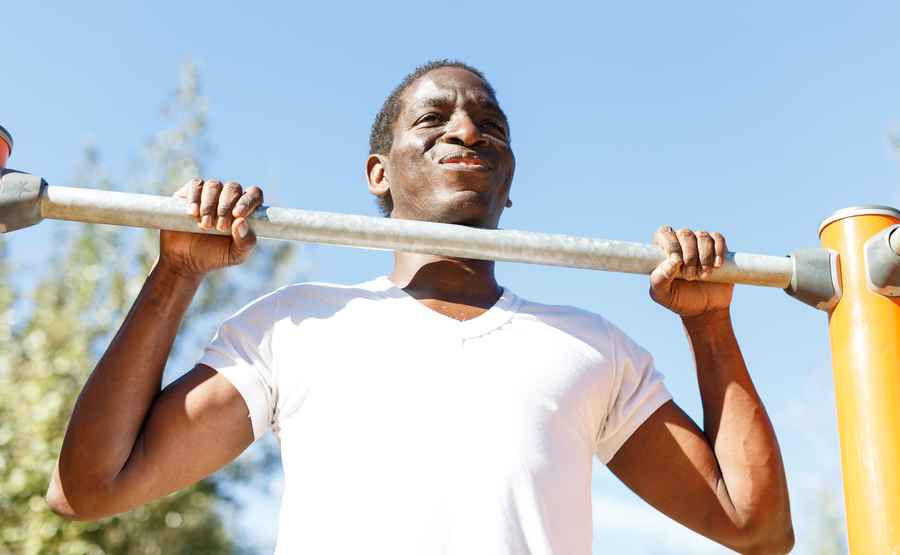
Lifting your entire bodyweight is no easy feat, so you can expect to develop stronger muscles in your back, arms, and shoulders when training to do pull-ups. This is particularly important in later life, as adults lose 3-5% of their muscle mass per decade after the age of 30.
Improve grip strength
Pull-ups are excellent for building grip strength, as they require a strong and sustained grip on the bar. Grip strength is often overlooked, but research shows it’s a strong indicator of overall wellbeing.
A weak grip has been linked to health complications from osteoporosis and rheumatoid arthritis, to obesity and diabetes. One study of 140,000 older adults even found that a frail grip was linked to higher incidences of stroke, heart attack, cardiovascular disease, and death. Interestingly, it was more accurate than blood pressure at predicting the risk of early death.
A good grip is also a key part of many everyday activities, from carrying shopping and gripping door handles to playing racquet sports and lifting weights.
Work multiple muscles at once
Pull-ups are ‘compound exercises’, meaning they recruit multiple muscle groups at once: shoulders, back, chest, arms, and core.
One scientific review in the Strength and Conditioning Journal examined the pull-up by breaking it into three phases – starting, ascending, and descending – noting that the same muscles are used in each phase.
Support bone health
Strength exercises, including pull-ups, can be great for bone health. They place weight and, therefore, force on bones, stimulating them to adapt and grow. This is particularly important as we get older, as we gradually start losing bone around the age of 35.
That said, pull-ups are still considered low-impact because they involve slow, controlled movements, rather than jarring ones with high-impact landings.
For help maintaining healthy bones, the Royal Osteoporosis Society (ROS) offers access to expert information and a chance to connect with others through supporter and volunteer groups, from just £3 a month.
Improve posture
The hanging element of pull-ups (known as a ‘dead hang’) can be great for elongating and decompressing the spine, relieving pressure on the lower back and improving posture. Some studies even suggest that dead hangs can help your back’s flexibility.
Plenty of ways to modify or advance
If you can’t do a pull-up yet, you can still reap the benefits by looping a long resistance band around the bar and resting a foot in it. The band will take some of your weight and make your pull-ups easier. Similarly, once you get comfortable with pull-ups, you can make things more challenging by wearing a dip plate around your waist with a weight plate attached.
You can also experiment with different grip techniques to keep things interesting. For example, taking a wider grip, turning your palms towards you and doing a chin-up, or using a mixed grip where one palm faces towards you and one away. For more ideas, check out this article from Opex.
Boost mental and physical health
Resistance training has been found to reduce anxiety and depression, and improve sleep, fatigue, and cognition in older adults. Research also shows it can increase lean muscle and metabolic rate, reduce the risk of type 2 diabetes, and boost overall physical performance, including walking speed and movement control.
Reward and satisfaction
Successfully achieving a goal you’ve spent time working towards is one of life’s great joys – and because pull-ups are considered one of the trickiest exercises in the strength training world, the rewards of completing them can be huge.
How to achieve your first pull-up in six weeks

If you already strength train, health experts suggest that 6-12 weeks is a suitable timescale to build your strength and achieve your first pull-up. PureGym recommends training six exercises during this time.
1. Dead hangs
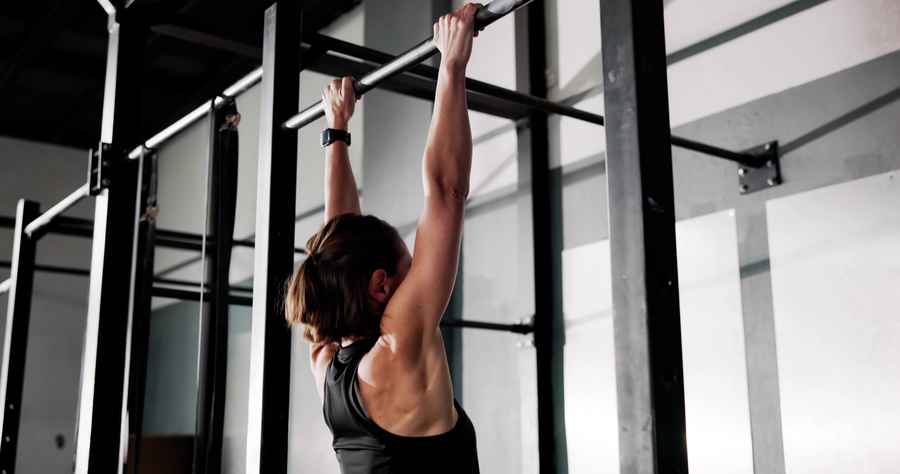
Dead hangs or ‘straight arm hangs’ are largely about developing grip strength and core stability. This will keep you from swinging when around and expending unnecessary energy during a pull-up.
To do this exercise, simply grip the bar (palms facing forward) and hang from it, so your arms are extended. Pull your belly button towards your sternum to engage your core muscles and allow your feet to come slightly in front of the body. Then, retract your shoulder blades, pulling them together, to allow your chest to lift slightly towards the bar.
If you’re struggling not to swing, try crossing your legs near your ankles. Hang for as long as possible.
2. Lat pulldowns
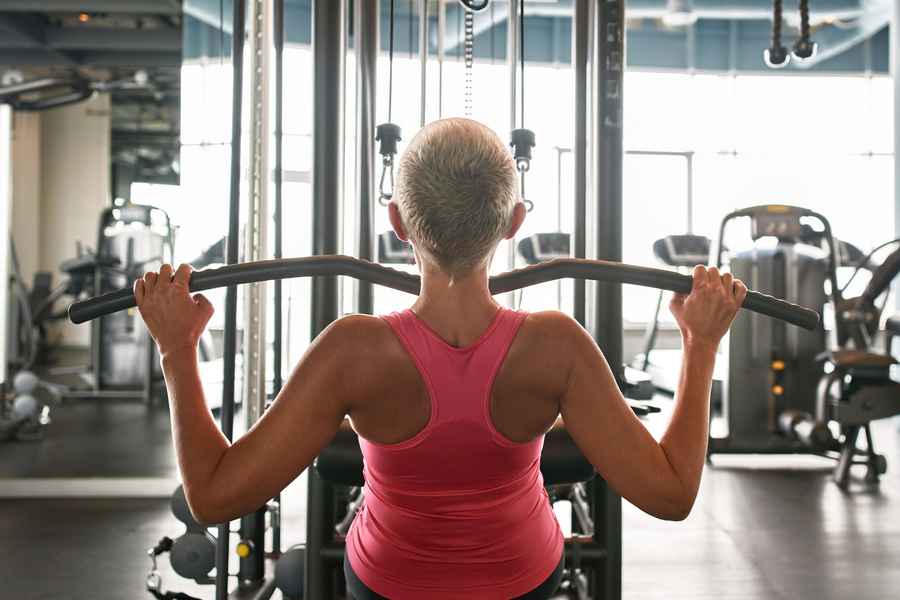
The lat pulldown machine is excellent for pull-up training, as it targets many of the same muscles, including the latissimus dorsi, posterior deltoids, rhomboids, trapezius, and biceps.
When using this machine, you take a seated position and pull the bar down towards your body. This is typically easier than a pull-up, as the seated position gives you more control and stability. You can also adjust the weight of the machine to suit you.
To do a lat pulldown, take a seat and adjust the pad so it sits tightly against your thighs. This will keep the movement controlled and prevent you from using unintended muscle groups. Stand to grip the bar; hands slightly wider than shoulder-width and palms facing away. Sit back down with feet firmly planted and arms extended.
Pull the bar toward your sternum, thinking about driving your elbows into your back pockets until the bar reaches just below your chin. Slowly reverse the movement, returning to the starting position by extending your arms in a controlled movement.
3. Assisted pull-ups
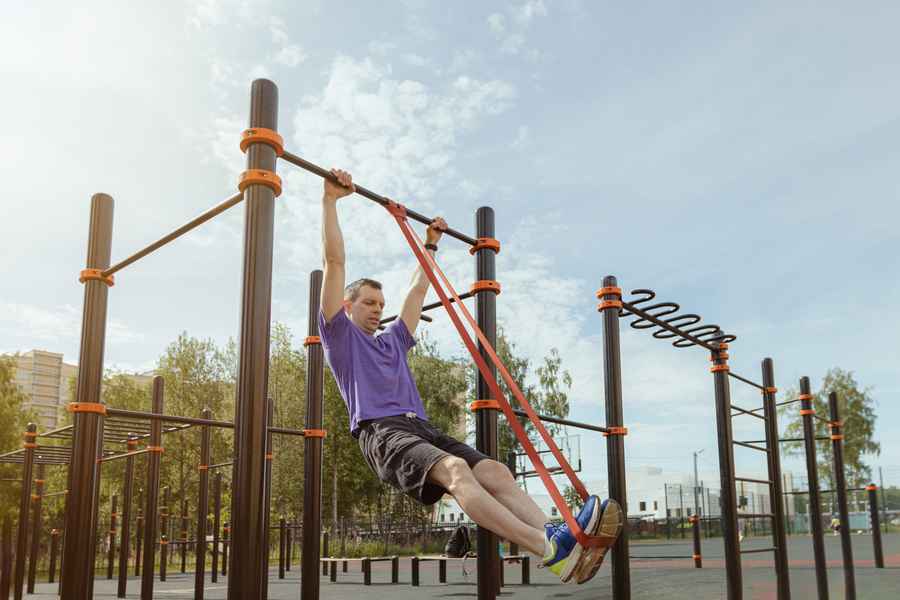
The movement of assisted pull-ups is similar to regular pull-ups – but you’re not lifting your entire body weight, making it easier. You can do assisted pull-ups using a machine at the gym or by looping a long resistance band around a pull-up bar and resting a foot in it to take some of your weight. Different bands hold different amounts of weight, and you may choose to use one band or two, one for each foot.
You can browse long resistance bands on Amazon. There are also plenty of sets available if you’re looking to start with a heavier band and progress to a lighter band.
If using a machine instead of a band, you’ll grip the pull-up bar (hands wide) and kneel on an assistance pad, which moves up and down as your arms fully extend and retract.
You can select how much weight the pad takes – and the more weight you select, the easier the exercise will be. For example, if you weigh 80kg and you select 80kg, you’d effectively be moving no weight; whereas if you selected 40kg, you’d be lifting half your body weight.
4. Single-arm dumbbell rows
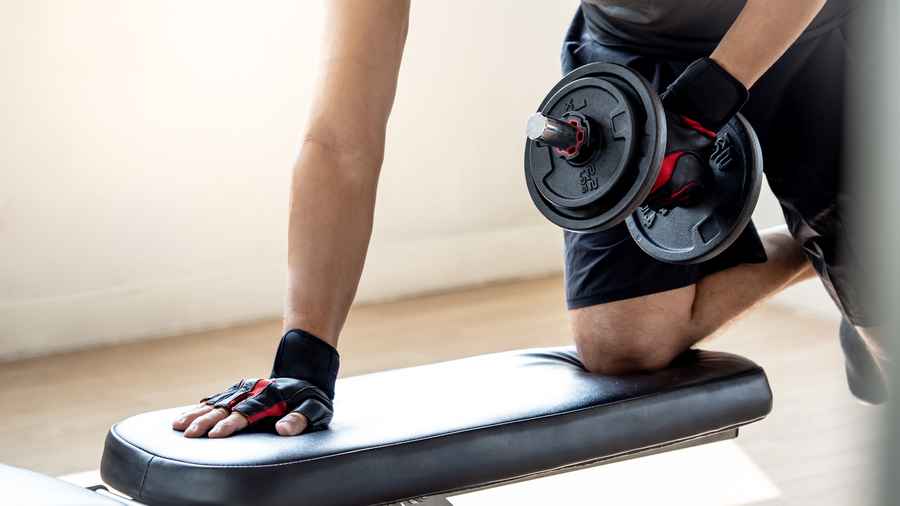
Dumbbell rows strengthen your back and biceps, two key areas involved in pull-ups. And working a single side at a time can help prevent muscular imbalances by giving each side an equal workout.
PureGym recommends starting with your weaker side to make sure you do the same number of reps on each side.
To do single-arm dumbbell rows, hold one dumbbell in your working hand while leaning over a bench, placing your opposite leg and hand on the bench for support. Plant your working-side foot firmly on the ground. Keep your spine neutral as you extend your working arm. Row the dumbbell toward your hip in an arc motion, then slowly return to the starting position with control. Switch sides after completing reps.
5. Alternating dumbbell bicep curls
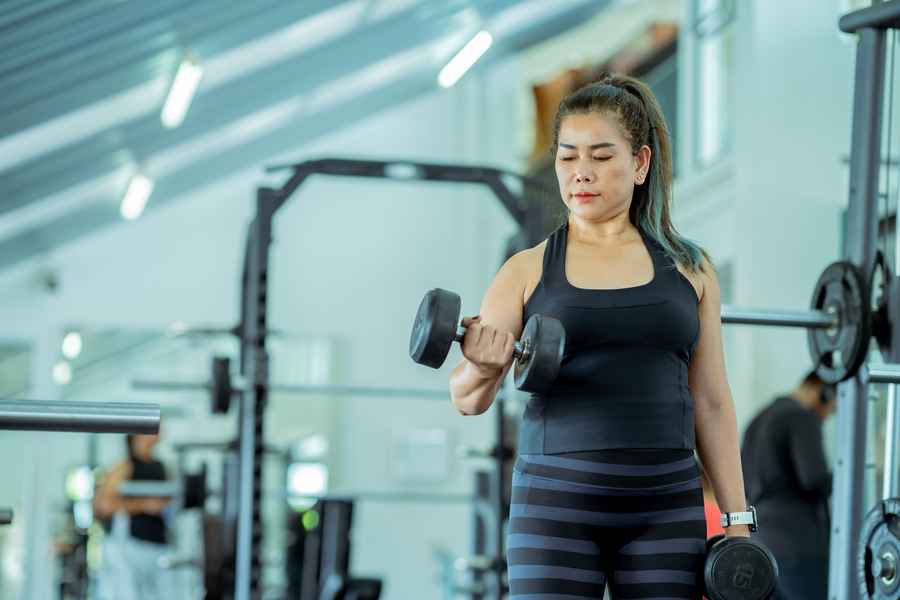
Like single-arm dumbbell rows, alternating dumbbell bicep curls are also intended to prevent imbalances and work your biceps evenly.
To do alternating bicep curls, stand with a dumbbell in each hand (underhand grip, palms facing away from you). Let your arms extend so the dumbbells rest beside your thighs. Begin reps by flexing at the elbow, keeping it pinned to your side while squeezing your bicep to curl the dumbbell toward the corresponding shoulder. Focus on contracting the bicep at the top, then slowly extend your arm back to the starting position before repeating with the other arm.
6. Eccentric pull-ups
Eccentric pull-ups, also known as ‘negatives’, are designed to get your body used to carrying a larger load. They focus on the part of the pull-up where your chin is above the bar and you begin to lower yourself back down.
The idea is to use a platform or box to allow you to reach and grip the bar and get into position: wide hand grip and chin above the bar (you may need to jump a little to get up there!). From here, once you feel stable, extend your arms to lower your body. The slower you can go, the more challenging it will be.
Once your arms are fully extended, step back on the box and return to the starting position, ready to repeat the movement.
How many reps and sets should I do?
The amount of reps and sets you do of each exercise will depend on you, but the most important element of strength building is training your muscles close to failure. The final two reps should be a real challenge to complete; otherwise, you may be able to lift heavier.
Different rep ranges also serve different purposes: low reps (3-5) with heavy weights build strength, moderate reps (6-12) with moderate weights build muscle size, and high reps (12+) with low weights improve endurance. As pull-ups are strength-focused and use heavy to moderate weights, prioritising lower and moderate rep ranges (3-8) will likely build strength quicker.
Experts recommend using 4-5 sets for low reps, 3-4 sets for moderate reps, and 2-3 sets for high reps to get enough training volume to support strength and muscle growth.
Final thoughts…
Pull-ups are one of the most challenging yet rewarding strength exercises, and with a little patience and consistency, you could achieve your first one in as little as six weeks.
So, if you’re looking for a new fitness challenge, why not give it a go?
For further reading, head over to our fitness and exercise section.
Can you do a pull-up? Or are you thinking of making it a goal? We’d love to hear from you in the comments below.
Elise Christian is Lifestyle Editor at Rest Less. She joined Rest Less in 2018 after achieving a first class Master’s Degree in Journalism from the University of Kent, and writes across a range of lifestyle topics such as mental health, home and garden, and fashion and beauty. Prior to this, she worked as a freelance writer for small businesses and also spent a year training to be a midwife. Elise spends her spare time going to the gym, reading trashy romance novels, and hanging out with loved ones. She also loves animals, and has a fascination with sharks and tornadoes.
* Links with an * by them are affiliate links which help Rest Less stay free to use as they can result in a payment or benefit to us. You can read more on how we make money here.
Join the discussion
Read our full commenting terms and guidelines