
- Home
- Health
- Healthy Mind
- The psychology of growing grey – why it’s more liberating than you think
How does Rest Less make money
We make money through advertising and commission from affiliate links, which enable us to offer Rest Less as a free service to our users. The content on this page may use affiliate links, which track traffic from our website to a third party provider and enable us to receive a commission or payment from any traffic we refer.
* Affiliate links on this page have an * next to them. We place enormous importance on our editorial independence and the integrity of our content which means that we will never change how we write about something as a result of an affiliate link.
Do you remember how you felt when you found your first grey hair? No matter how old you might’ve been when you spotted that silver strand, there’s a good chance you weren’t thrilled about it.
This applies to both sexes, but it’s particularly the case for women. Studies suggest that 82% of women immediately pluck their first grey hairs – and nearly three-quarters (74%) begin dyeing their hair once greying takes effect. Men, on the whole, seem happier to let nature take its course – but 31% still pluck their first greys, and 18% later start dyeing their hair.
The grey revolution – where did it begin?
Fighting going grey is nothing new. The Ancient Egyptians used henna to hide greys, and natural hair colouring was also used by the Ancient Greeks and Romans. Permanent hair colour as we know it today wasn’t developed until the 20th century, and this was when the trend of dyeing grey hair – and being open about it – really kicked off.
But, in the past five years or so, there’s been a marked shift. The forced closure of hair salons during the pandemic caused millions of us to confront the true colour of our hair, leading to what’s been described as ‘the grey revolution’. While many people turned to home-colouring, others decided, for the first time, to stop dyeing their hair and own their greys.
Revealingly, those who have embraced the ‘grey positivity’ movement describe allowing their hair to go grey as an overwhelmingly positive experience. The words “empowering” and “freeing” are often used, with people noting that going grey had a positive impact on many areas of their lives. While some benefits, like freeing up more money, were anticipated, others were wholly unexpected.
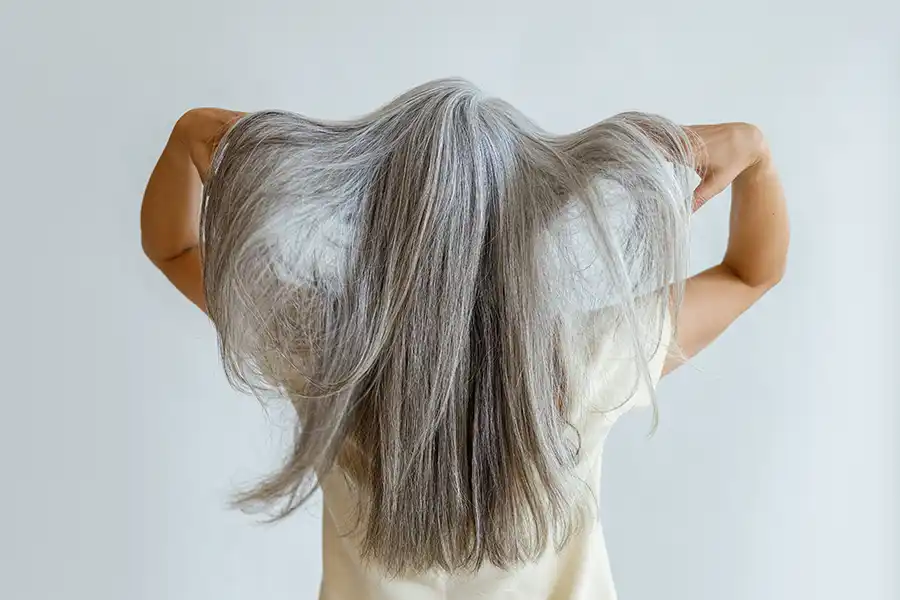
So why is deciding to embrace our grey hair often such a profoundly positive – and powerful – decision? And why are so many of us afraid to take the plunge? Let’s explore the psychology of going grey.
Why do we fight our greys?
The first thing we need to understand is what people fear about going grey – and why so many of us fight it.
The simple reason is that grey hair is one of the most common signs of ageing. Most of us will go grey at some point in our lives, and if you’re over 50 and yet to see a grey, you’re a rare minority. Hair colour comes from melanin and, as we get older, the pigment cells in the melanin die. The reduction of pigment is what makes hair turn grey, and when there’s no pigment left at all, it turns white.
Allowing nature to take its course shouldn’t be a big deal…yet often, it is. But it isn’t the passage of time that makes people fight the signs of ageing; it’s ageism. The media and society batter us with messages that wrinkles should be reversed, grey hair is frumpy, and ageing is to be feared. Yet, while there are some obvious downsides to getting older, multiple studies show that people aged 60+ are happier than younger people.

Although our own internalised ageism can make ageing – and going grey – difficult to confront, sexism plays a part, too. Men were often celebrated as ‘silver foxes’, yet historically, no similar badge of honour was ever awarded to women. Female celebrities have frequently been shamed for having grey hair, while their male counterparts, from George Clooney to Idris Elba, were lauded for their ‘sexy’ salt-and-pepper hair.
But ageing isn’t something to be ashamed of. Nor is it something to be fixed, halted, or cured. It’s a natural, lifelong process that unites us, because every one of us will – if we’re lucky – get old. It was Mark Twain who supposedly wrote, “Do not regret growing older. It is a privilege denied to many” – and it’s only when we accept ageing that we can begin to embrace it. And, once you break free from societal pressure, you may find it curiously liberating.
New degrees of self-acceptance
Those who have decided to embrace their greys often say that the process allowed them to be their most authentic selves. “I am now living my true self,” says 57-year-old Lisa Sparrow. “I feel liberated, free, and released. It is, by far, the most empowering and wonderful thing I have ever done for myself.”
Shedding societal expectations can feel immensely powerful, and it is: you’re effectively rejecting ageism and the pressure to conform to impossible beauty standards.
By challenging the social norms that equate beauty with youth, you may also discover a renewed confidence. You can redefine what beauty means to you; grey hair, just like wrinkles, can be viewed as a sign of maturity, wisdom, and a life well-lived. Letting go of the need to dye your hair every few weeks or months is a message to yourself that you, in your natural state, are enough. Your hair colour doesn’t determine your self-worth.
The ripple effect of going grey
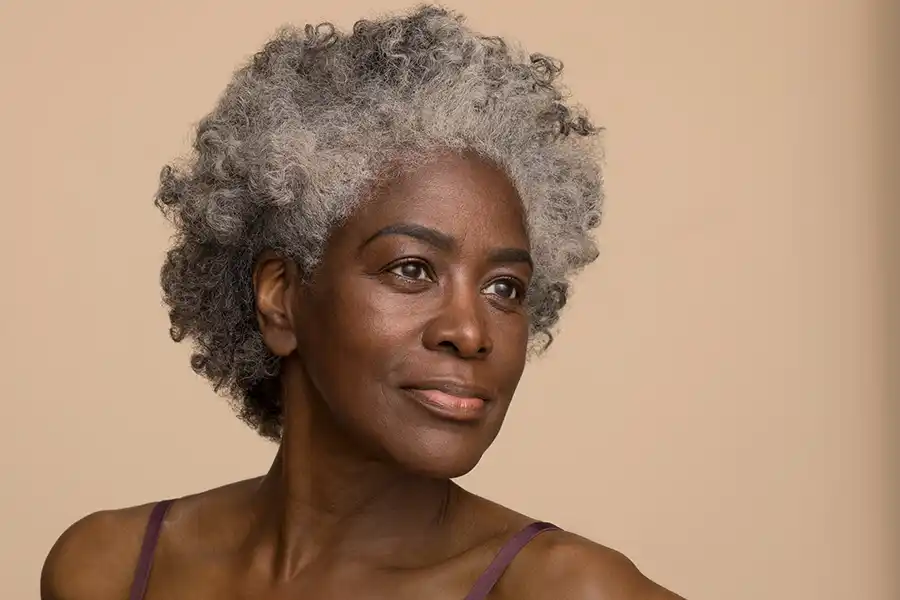
Men and women who have embraced their greys also often report that the decision had a positive ripple effect in other areas of their lives. You may feel braver, more confident, or rebellious and non-conformist. You may find yourself far more ready to step outside your comfort zone. And, rather than fixating on the way you look, you can turn your focus more to personal growth and enjoying life.
“I have grown bolder in word and deed, less afraid to stray outside my comfort zone,” journalist Louise Pendry wrote in The Guardian. “I have scrutinised my lifestyle and made changes. My diet has improved. I’ve embraced regular exercise. Rather than buying the latest face cream, I’m actively investing in my current and future health more generally because I want to enjoy this phase.”
Then there are the financial benefits. If you get your hair coloured in a salon, it costs an average of £71 each time. Depending on how quickly your hair grows, you may need to touch up the colour every four to eight weeks – which means you can be spending nearly £1,000 a year on dyeing your hair. And that’s without factoring in things like highlights, which are considerably more expensive. What else could you do with that money?
While you can dye your hair at home, which is cheaper, this can be messy and time-consuming, and the results are often underwhelming. Plus, you’ll always be on the back foot; as time passes, the greys will only come thicker and faster. Do you really want to be peering in the mirror every few weeks, assessing your roots and determining whether it’s time for another dye job? Life is short, after all – and precious.

How to go grey gracefully
If you’re tempted to go grey, there’s never been a better time to take the plunge. Not since the 18th century has grey hair been so on trend – and it’s now seen on the catwalk as well as red carpets.
Celebrities embracing the grey include Andie MacDowell, Salma Hayek, Steve Carell, Jamie Lee Curtis, Sarah Jessica Parker, Hugh Grant, and Helen Mirren. The trend has transcended mere celebrity, however; the famously glamorous Queen Letizia of Spain has been sporting elegant silver streaks for years now.
If you’re looking for inspiration, head over to social media: there are 2.9 million posts under the hashtag #greyhair on Instagram, and a further 2.9 million #silverhair posts. If you’d like to embrace your grey hair, there are two main options: ‘grow grey’ or ‘dye grey’. The first involves growing your grey hair out, and if you’re not fussed about obvious demarcation lines, this is the simplest and cheapest option. This is also a good choice if you have silver streaks or aren’t ready to go grey all over.
The other option is having a professional grey colour job at a salon. It’s best to make sure you have some visible grey regrowth, though – that way, your stylist can blend your natural grey roots with the rest of your hair. Even if you want to grow your grey hair out naturally, it can be good to go to the salon first, as there are ways you can gradually transition between colours as your hair grows. Or you may just want to have a consultation to chat through your options.
Final thoughts…
With all that said, remember that growing grey is an option and a choice. If you like the way you look with coloured hair, there’s nothing wrong with continuing to dye it – but knowing you don’t have to can be powerful. Often, when something becomes a choice, it’s no longer something we dread.
Adopting a sense of agency about going grey can make you feel positively involved in the ageing process – and there’s clear evidence showing that a positive outlook towards ageing can increase longevity. It can also act as the conduit to a simpler yet richer life.
Giving up the false illusion that we can stop the ageing process, and working with our natural self, not against it, can be uniquely liberating. It can be the marking of a new chapter; a sign that you’re in a new stage of life – and ready to get living, not “dyeing”.
For more on grey hair, you may like to read our article: 9 tips for gorgeous grey hair.
Have you embraced your greys? If not, are you tempted to join the ‘grey revolution’? We’d love to hear about your experiences in the comments below.
Selene Nelson is an author, freelance journalist, and lifestyle writer for Rest Less. After graduating from the University of Sussex with a degree in English Literature, Selene began contributing to many major newspapers and websites, and has written for the BBC, The Sunday Times, The Independent, Town & Country, and HuffPost. Her specialist subjects include food, travel, and health, though she enjoys writing about a wide range of topics (e.g. her two books are about veganism and psychopathy, respectively!). She enjoys cooking (particularly pasta and Asian noodle soups), reading, travelling, hiking, attempting to keep fit, and watching animal videos on YouTube.
* Links with an * by them are affiliate links which help Rest Less stay free to use as they can result in a payment or benefit to us. You can read more on how we make money here.
Join the discussion
Read our full commenting terms and guidelines