
- Home
- Leisure & Lifestyle
- Art & Culture
- 6 celebrations of death and the supernatural from around the world (that aren’t Halloween)
How does Rest Less make money
We make money through advertising and commission from affiliate links, which enable us to offer Rest Less as a free service to our users. The content on this page may use affiliate links, which track traffic from our website to a third party provider and enable us to receive a commission or payment from any traffic we refer.
* Affiliate links on this page have an * next to them. We place enormous importance on our editorial independence and the integrity of our content which means that we will never change how we write about something as a result of an affiliate link.
Spirits and supernatural tales aren’t just reserved for Halloween. Around the world, many cultures set time aside for the more macabre aspects of life – from Mexico’s famous Day of the Dead to ‘Witches Night’, celebrated throughout Northern Europe.
On the surface, these occasions may seem spooky, but dig deeper, and you’ll discover their real intentions. More often than not, they’re joyful times for honouring lost loved ones, cherishing those still with us, and generally celebrating life.
So, as Halloween approaches, we’ve spotlighted six other celebrations of death and the supernatural from around the world.
1. Gai Jatra (Nepal)
According to Nepalese legend, 17th-century King Pratap Malla consoled his wife after the death of their son by staging a parade. To show her that she wasn’t alone in grief, the king asked anyone in the kingdom who’d also lost a loved one to join the procession, which became the very first Gai Jatra.
The Newar people of the Kāthmāndu Valley celebrate Gai Jatra to this day. It falls in the month of Bhadra on the Nepali Calendar (sometime in August or September), and it’s still typically marked by a parade to commemorate friends and family who died in the past year. As with the original, it’s cheerful and unifying – featuring flamboyant costumes, song, dance, and even comedy sketches.
Gai Jatra translates to ‘Festival of Cows’. In Hinduism, cows are sacred figures, and families lead them through the procession to guide loved ones into the afterlife. If a family doesn’t have a cow, they might dress one of their children up as one instead.
Like many of the festivals listed here, customs vary between regions. According to Condé Nast Traveller India, people from Bhaktapur stage a large cavalcade of chariots, with some men donning sari-style garments usually worn by women. While in Kirtipur, people dress themselves as gods and goddesses and pray for deceased relatives.
2. Día de los Muertos (Mexico)
On the first two days of November, Mexico erupts in a celebration of song, dance, and colour.
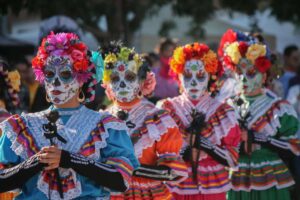
Far from the sombre affair you might expect, Día de los Muertos (Day of the Dead) is a joyful time for celebrating passed loved ones, briefly welcoming their souls back to the land of the living, and facing death with a life-affirming attitude.
Rooted in Mexico’s pre-Hispanic traditions and later blended with Catholic observances, the festival has evolved into one of the country’s most vibrant cultural expressions, embraced at home and by Mexican communities worldwide.
Families create altars, or ofrendas (offerings), in their homes and at their loved ones’ gravesides, to welcome them back to the mortal plane. These are filled with candles, photos, their favourite food and drinks, and yellow marigold flowers, said to guide souls back to their resting places.
In urban areas, festivities are grand. Fabulous parades wind through the streets, with revellers donning elaborate costumes and skull makeup, while papel picado (delicate tissue paper decorations) flutter overhead.
To learn more about Día de los Muertos, tune into our online talk on Friday 31st October over on Rest Less Events.
3. Walpurgis Night (Northern Europe)
Walpurgis Night – also known as Walpurgisnacht or ‘Night of the Witches’ – is a festival celebrated throughout Scandinavia and other Northern European countries, such as Estonia and Germany, on the last night of April.
According to German legend, this is when witches meet at Brocken (the tallest peak in the Harz Mountains) to convene with the devil and conduct dark rituals. To ward off evil, people play loud music and set off fireworks – and much like Halloween, they dress up in costumes and play pranks.
In Sweden, Walpurgis Night is called Valborg – and the celebrations take on a markedly different character. Communities gather to light big bonfires and choirs sing folk songs to welcome spring, after which many people retire to pubs, restaurants, and parties.
At the same time, Finland erupts in a lively carnival called Vappu, complete with picnics, sparkling wine, and plenty of balloons. Vappu is strongly associated with students, with crowds gathering in Helsinki’s Market Square to watch a crane place a graduation cap on a mermaid statue.
Despite their varied traditions, these fantastic festivals share common roots in pagan celebrations of spring and fertility, combined with Christian observances – particularly the legend of English-born Bavarian nun Saint Walpurga, famous for curing illnesses and fighting witchcraft.
4. Obon (Japan)
If you’re visiting Japan in late summer, you might notice people hanging lanterns on housefronts and lighting fires in entranceways. This is mukaebi, one of the main traditions of Obon (or Bon), an annual Buddhist festival that commemorates the dead.
During this time, it’s believed that departed souls, guided by lanterns and fires, temporarily return to their birthplaces to visit their ancestors. At the end of Obon, people light more fires and float lanterns onto seas, lakes, and rivers (okuribi) to help usher the souls back to the spirit world.
The festival is rooted in Buddhist scripture – specifically the story of a disciple who found his mother in the Realm of Hungry Ghosts, where lost souls are stuck in a cycle of unquenchable hunger and thirst. To save her, the Buddha told his disciple to leave out food and drink and make an offering to the monks on the 15th day of the seventh moon.
Obon celebrations vary between regions, with some observing it in July and others in August. People often take time off work to return to their family homes, where rituals are carried out, such as making shōryō-dana (altars filled with flowers, incense, fruit, and sweets). It’s common to make two of these – one for ancestors and another for other restless spirits.
During Obon, people also attend prayer services at temples, clean and decorate their family’s burial places (ohakamairi) and stage bon-odori, traditional group dances.
5. Fèt Gede (Haiti)
Haiti is home to one of the world’s liveliest and most vibrant festivals of the dead: Fèt Gede.
It’s celebrated by practitioners of Vodou, one of Haiti’s most popular religions (not to be confused with the harmful stereotype of ‘voodoo’ spread by Hollywood and other popular Western media).
On the 1st and 2nd of November, people parade through the streets, singing, dancing to drumbeats, and sipping rum drinks made with spicy peppers – some even dousing their bodies in them.
Like many of the festivals on this list, the purpose of Fèt Gede is to pay respect to passed loved ones. Parades typically end up in cemeteries, where candles, food, and drink are placed at graves.
Revellers often dress in the colours of the spirit Papa Gede (black, white, and purple), who is believed to be the first person who ever died and now leads souls into the afterlife. Many people don sunglasses and top hats, and carry canes – other symbols of Papa Gede. During Fèt Gede, the spirits of loved ones are also thought to possess certain ancestors’ bodies.
6. Samhain (UK and Ireland)
Many of today’s Halloween traditions evolved from this ancient Celtic fire festival, which ushered in the darker half of the year.
During this time (usually 31st October to 1st November), pagans believed the veil between the mortal realm and the gods’ world was at its thinnest, meaning all kinds of deities, spirits, and ghosts would come to wreak havoc on Earth.
To appease them and ensure a good winter, worshippers would make sacrifices and offerings, and light bonfires as protection from malevolent entities. According to the BBC, “they would dance around and act out stories of death, regeneration and survival.” People donned costumes, too, hoping to disguise themselves from harmful otherworldly beings.
However, things began to change when Christianity arrived in the UK and Ireland. As Cady Lang writes in Time Magazine, “during this time, many […] Celtic traditions were reframed with a Christian narrative in an attempt to capitalize on the popularity of the pagan practices while spreading the new religion.”
However, traces of these pagan practices still exist in our modern Halloween celebrations. As well as dressing up in scary costumes, ancient Celts carved root vegetables, such as turnips and potatoes, much like we do with pumpkins. They also left sweet cakes on doorsteps to repel evil spirits – a practice sharing similarities with today’s trick-or-treating.
Many modern pagans around the world still celebrate versions of Samhain. Festivities may include feasts, remembering deceased loved ones, and traditional games like apple bobbing.
Final thoughts…
While these celebrations might seem macabre on the surface, they reveal something beautifully universal: our capacity to confront the painful and unknown aspects of life with joy, artistry, and togetherness.
Whether it’s children dressing up as cows in Nepalese parades or families creating vibrant graveside vigils in Mexico, these festivals remind us that, even in the face of death, life is to be celebrated.
To learn more about cultural expressions from around the world, check out our art and culture section. Here, you’ll find guides on specific celebrations (from Diwali to Burns Night) and round-ups, such as 10 unique Christmas traditions from around the world.
Would you like to shout out any celebrations that didn’t make the list? We’d love to hear from you in the comments below.
Sam McLoughlin is a Senior Lifestyle Writer at Rest Less. He joined the editorial team in 2021 after completing his Master’s degree in English Literature, Culture, and Theory at The University of Sussex. He enjoys writing about careers, books, sports, travel, and pretty much anything that his editor will let him have a crack at, but his favourite part of the job is interviewing inspiring people – from activists and CEOs to later life career changers. In his spare time, Sam enjoys climbing, snowsports, and going to see live music.
* Links with an * by them are affiliate links which help Rest Less stay free to use as they can result in a payment or benefit to us. You can read more on how we make money here.
Join the discussion
Read our full commenting terms and guidelines