
- Home
- Leisure & Lifestyle
- Art & Culture
- 10 of the most famous artworks in history
How does Rest Less make money
We make money through advertising and commission from affiliate links, which enable us to offer Rest Less as a free service to our users. The content on this page may use affiliate links, which track traffic from our website to a third party provider and enable us to receive a commission or payment from any traffic we refer.
* Affiliate links on this page have an * next to them. We place enormous importance on our editorial independence and the integrity of our content which means that we will never change how we write about something as a result of an affiliate link.
One of the wonderful things about art is that it’s subjective. One person can look at a painting and be profoundly moved, while someone else can look at it and feel very little. But some artworks are so beautiful, powerful, or impressive that they transcend taste.
These artworks are so famous that they’ve become part of our culture. You might never have viewed them in a gallery, but you’ve probably seen them referenced in films or adverts. And even if these pieces of art aren’t to your taste, there’s a good chance you’ll appreciate the skill behind them – as well as their cultural and historical impact.
So, what are the best examples of these masterpieces? From enigmatic smiles to towering marble sculptures, here are 10 of the most famous artworks in history.
1. Mona Lisa – Leonardo da Vinci
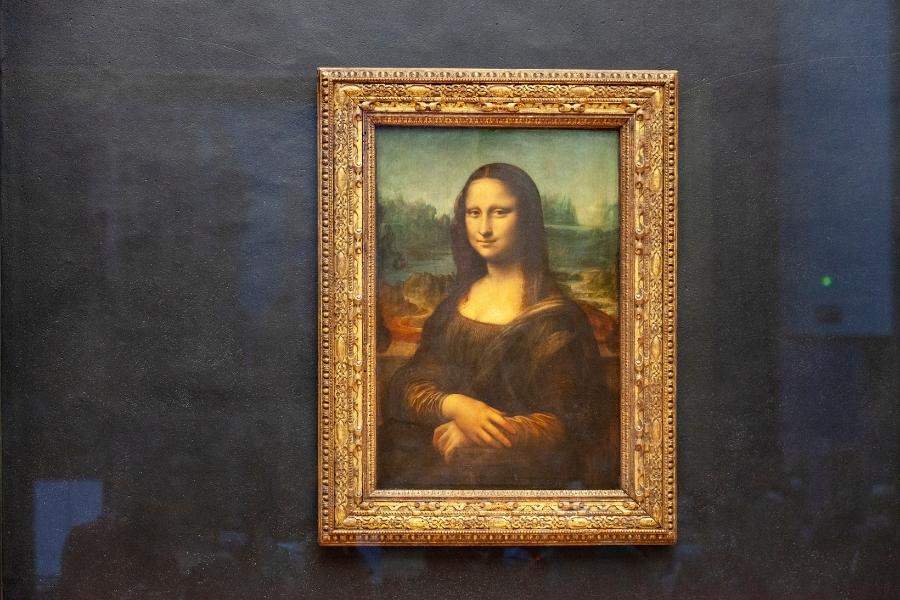
Let’s start with what’s arguably the most famous painting in the world: Leonardo da Vinci’s Mona Lisa.
Painted around 1503–1506, this surprisingly small painting (77cm × 53cm) now hangs in Paris’ Louvre Museum, where it draws millions of visitors each year. Part of its appeal lies in its mystery; though most experts believe the woman in the picture is Lisa Gherardini, the wife of a Florentine merchant, we can’t be entirely certain.
Nor can we know why she’s smiling so enigmatically, as though she’s hiding a secret (though, if you’ve read The Da Vinci Code, you’ll know there are many theories about this). Her mysterious smile seems to shift depending on how you look at it, and she can look amused, knowing, sly, or serene.
Another reason for the painting’s legendary status is its dramatic history: it was stolen from the Louvre in 1911. The crime caused international headlines, and when it was recovered two years later, the painting had become world-famous.
Add in Leonardo’s soft, blended sfumato technique, the eyes that follow you, and the dreamlike landscape, and it’s easy to see why this painting still captivates so many.
2. The Starry Night – Vincent van Gogh
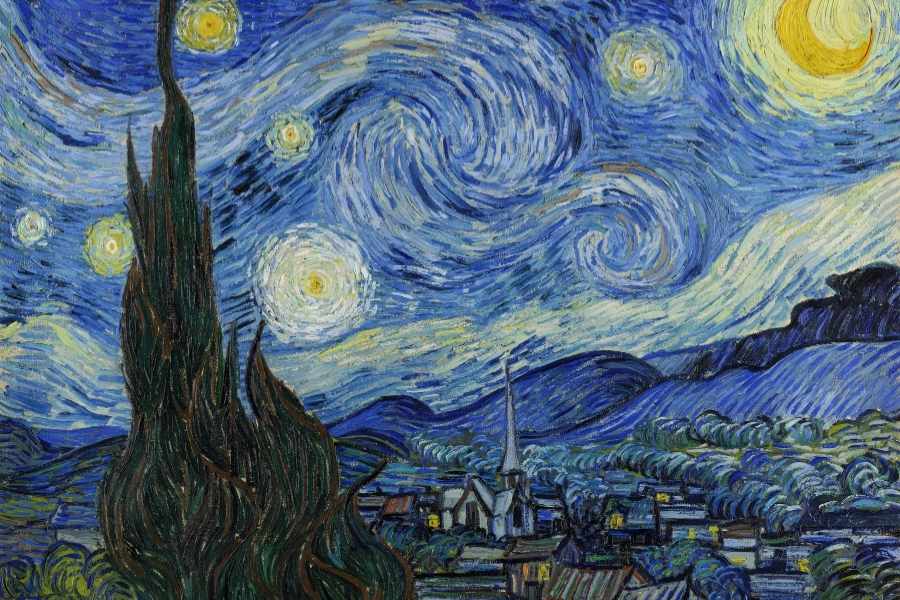
Vincent van Gogh’s The Starry Night is another of the world’s most famous paintings. Created in 1889, this masterpiece now hangs in New York’s Museum of Modern Art.
After experiencing a severe mental health crisis, Van Gogh admitted himself to an asylum in Saint-Rémy-de-Provence, in the south of France. The Starry Night was painted from a window in the asylum and is often seen as a reflection of Van Gogh’s mind – his turmoil and instability, his awe at nature, and his search for meaning.
What’s striking about this painting is how alive it feels. Unlike traditional night scenes, the sky is full of swirling blues and glowing stars that seem to move across the canvas, giving the impression that the painting is alive. It feels emotional rather than realistic.
Sadly, Van Gogh worried this painting was a failure, believing it was too abstract and not realistic enough – which is ironic, given that its abstract elements are precisely why it’s so celebrated today. The painting resonates because it feels so personal. It’s not about what the world really looks like, but what it feels like to exist within it.
3. David – Michelangelo
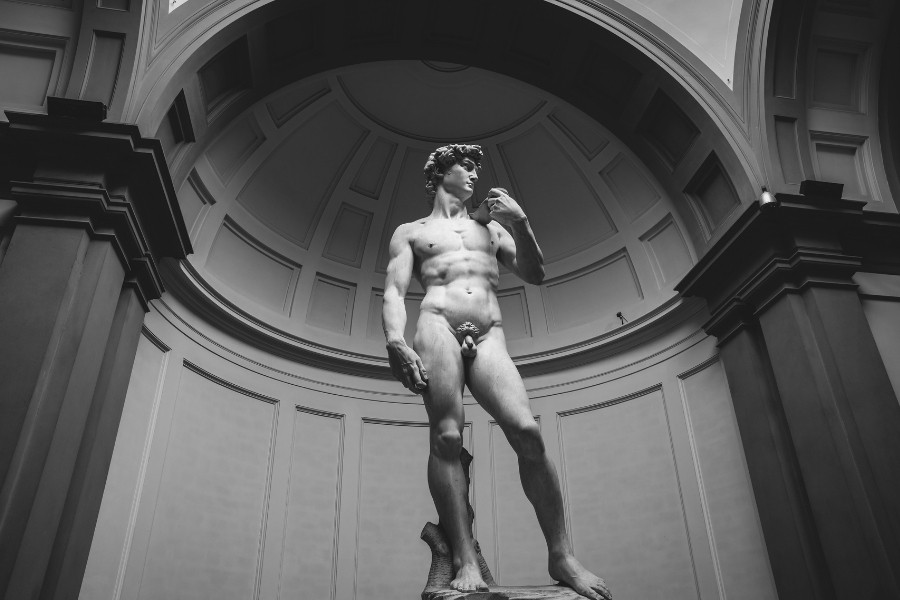
Not all the world’s most famous artworks are paintings. Michelangelo’s David is a marble sculpture created between 1501 and 1504, and, standing in Florence’s Galleria dell’Accademia, it remains just as impressive today as it was at its unveiling.
The sculpture depicts the biblical hero David right before his battle with Goliath. Unlike other, earlier versions of David, which showed him after his victory, Michelangelo chose to depict him before. This decision means the sculpture is full of tension: there’s no raised sword or dramatic poses…just an alert, tense David, his brow furrowed, and his gaze focused.
The scale and skill of the statue are astonishing. Standing over 17 feet tall, David was carved from a single block of marble. Other sculptors had rejected this block as flawed…yet, Michelangelo turned it into one of the greatest sculptures ever made.
The sculpture’s realism is also remarkable. There are visible veins in the hands and details in muscle tone, making it feel less like a carved statue and more like a living figure, frozen in time.
While David reflects Renaissance ideals – beauty, balance, human potential – what makes it so compelling is its psychological depth. It captures a moment of quiet anticipation, making the figure feel both powerful and human.
4. Guernica – Pablo Picasso
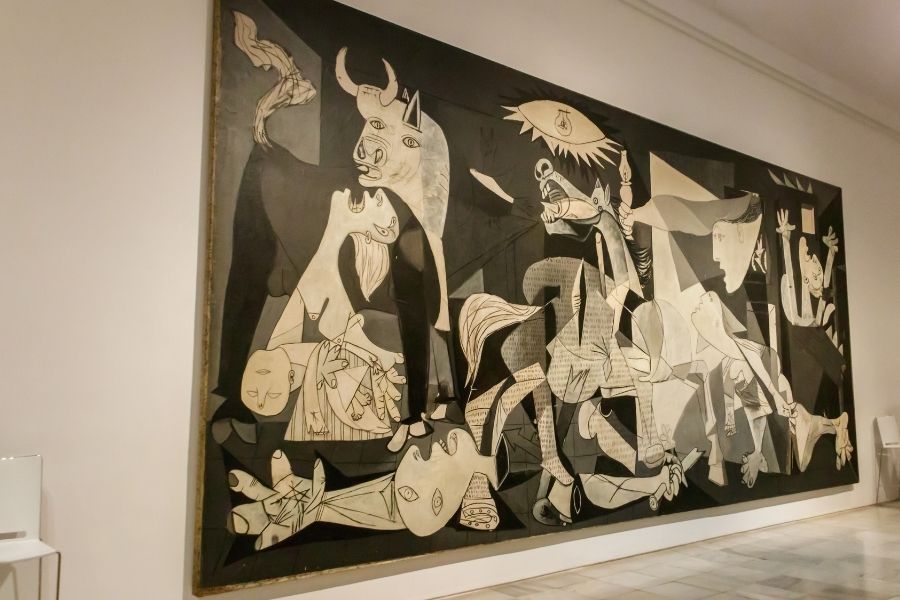
Picasso created around 50,000 artworks in his lifetime…but his most famous work is arguably Guernica. Painted in 1937, it isn’t just art; it’s a powerful anti-war statement. It was created after the bombing of the town of Guernica during the Spanish Civil War, and has since become one of the most enduring images of the brutality of war.
Rather than depicting the event realistically, Picasso shows the horror through fractured, distorted figures: there’s a screaming horse, a fallen soldier, a mother holding her dead child. It all feels broken and disjointed, as if the world itself has fallen apart.
Picasso’s decision to paint only in black and white makes the scene feel like a newspaper photograph: stark, cold, and immediate. Despite the distortion, it still feels disturbingly real. The fragmentation of the figures helps you actually feel the violence and layers of anguish, rather than passively observing it.
5. The Scream – Edvard Munch
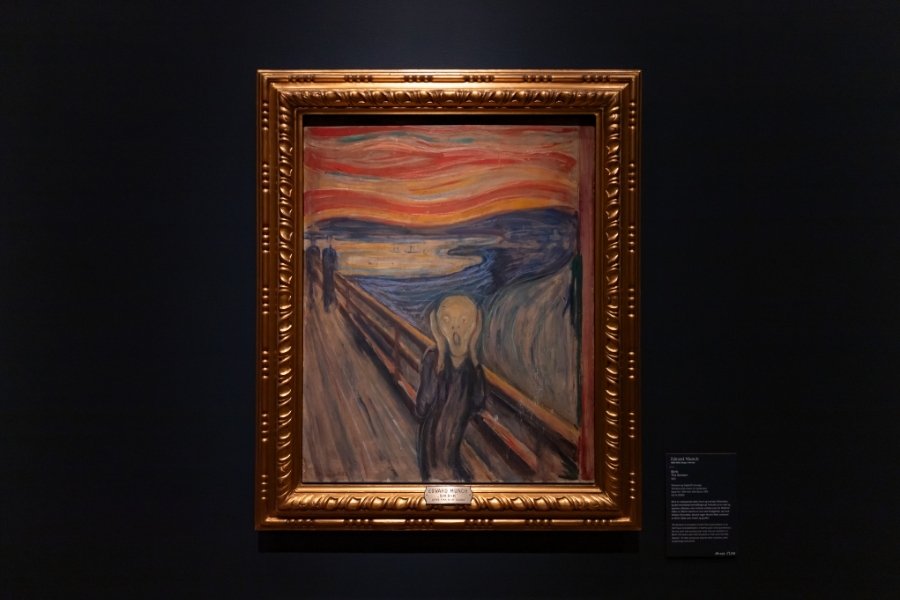
Painted in 1893 by Edvard Munch, The Scream has become one of the most recognisable images in art history. Hanging in the National Museum of Norway, it’s the opposite of paintings like the Mona Lisa. Rather than inviting quiet reflection, The Scream immediately confronts you with its visceralism.
The story behind the painting is fascinating. Munch was walking at sunset when the sky turned blood red, and he was hit by a wave of anxiety. He wrote in his diary: “I sensed a scream passing through nature; it seemed to me that I heard the scream.” And that’s what the painting captures – not a person screaming, but the feeling of a scream.
The screaming figure isn’t realistic or detailed, and its ghost-like, abstract appearance makes it more relatable. It feels as though it could be anyone. The two people in the background continue walking, oblivious to the figure’s distress, emphasising a very modern type of isolation: surrounded by people, yet entirely alone.
This is part of why The Scream still resonates today. It’s become a symbol for modern anxiety, tapping into feelings of existential dread and capturing something many people recognise but struggle to describe.
6. The Last Supper – Leonardo da Vinci
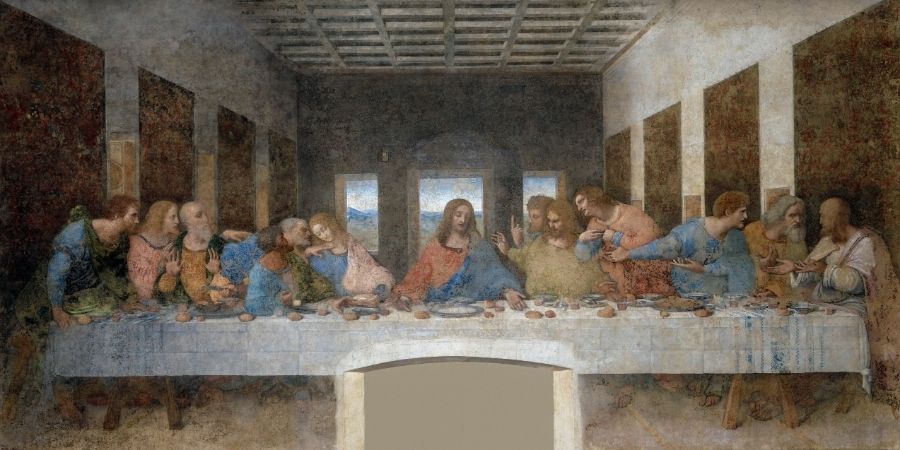
Another Leonardo masterpiece makes the list – this time, The Last Supper.
Painted between 1495 and 1498 onto a wall of Milan’s Santa Maria delle Grazie, this iconic mural captures the moment Jesus reveals that one of his disciples will betray him. He sits at a table with his 12 apostles, whose varying reactions of shock, disbelief, and anger are what the scene’s all about.
Judas (the betrayer) isn’t isolated or tucked away. He sits with the others, close to Jesus, clutching a small bag – often interpreted as the silver he’ll receive for his betrayal. Jesus sits in the centre, calm and composed, a visual anchor in the chaos.
The painting is famous for its masterful composition and linear perspective: everything in the painting, from the walls to the ceiling lines to the arrangement of the apostles, leads the eye to Jesus.
Leonardo experimented with a new fresco technique for The Last Supper, which ironically started deteriorating almost immediately. It’s survived centuries of damage and restoration, only adding to its mythic status.
7. The Birth of Venus – Sandro Botticelli
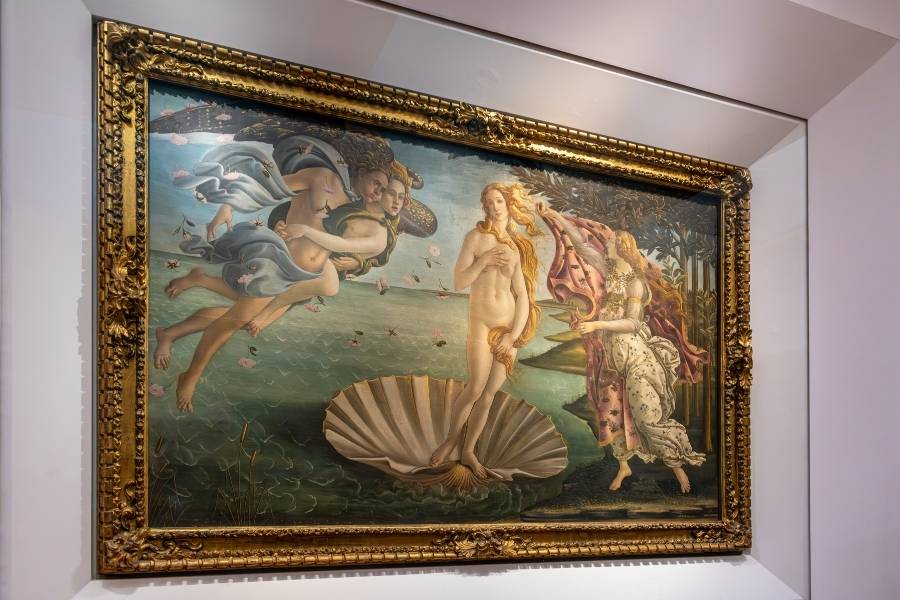
Painted in the late 15th century, The Birth of Venus depicts the goddess of love, Venus, arriving on shore in a shell after being “born” in the sea. She’s being blown towards land by the wind god Zephyrus, while on the right, a woman waits to cover her with a cloak.
The painting’s flowing lines and ethereal beauty helped define Renaissance ideas of divine beauty. Venus isn’t painted as a real woman, but as an ideal. Her proportions are intentionally stretched to enhance elegance over accuracy, and her elongated neck, soft expression, and smooth skin capture Renaissance beauty standards.
At a time when most art was religious, Botticelli chose to paint a scene from classical mythology – a bold shift that reflected the humanist thinking of Renaissance Florence. It isn’t trying to capture reality; it’s trying to portray an otherworldly beauty.
8. Venus de Milo
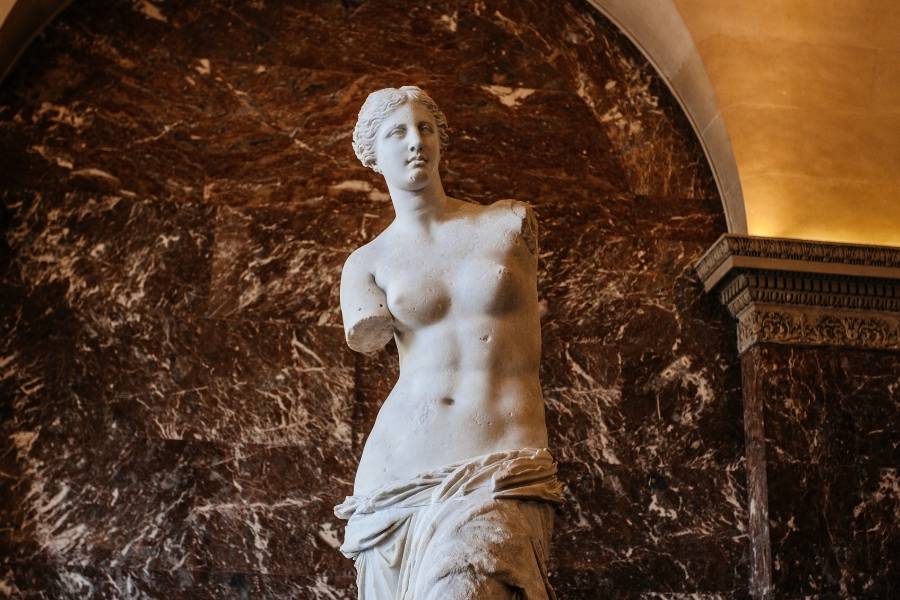
This next artwork is arguably the most mysterious on the list. Created between 130 and 100 BCE by an unknown artist, it’s also the oldest. The Venus de Milo is one of the most famous sculptures from ancient Greece, and is believed to represent Aphrodite, the Greek goddess of love and beauty (Venus is the Roman equivalent).
The statue was discovered in 1820 on the Greek island of Milos and was instantly taken to France, where it remains today, displayed in the Louvre. No one knows what she was originally doing with her arms; some say she was holding an apple, adjusting her drapery, or resting on a column – but there’s no way to be sure, and that mystery has only added to her appeal.
Unlike later depictions of Venus, like Botticelli’s, this version isn’t unrealistic. Her body is naturalistic, and the contrast between smooth skin and textured material enhances the sense of realism. There’s strength and confidence in her posture, while her calm expression gives the sculpture a timeless quality.
9. The Creation of Adam – Michelangelo
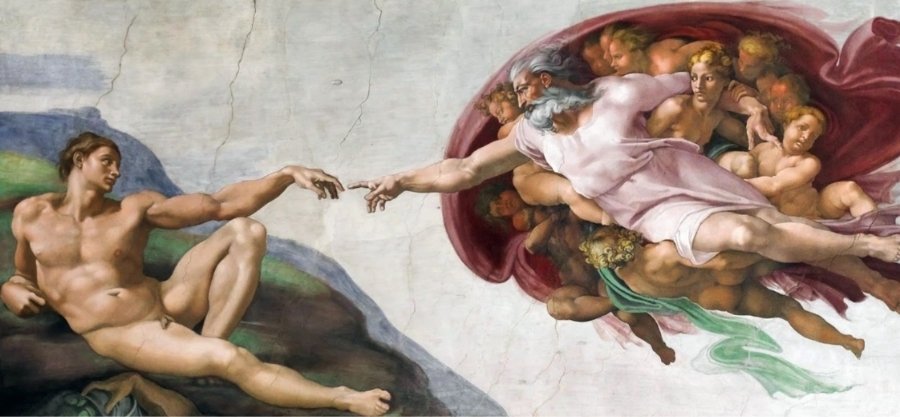
Another Michelangelo masterpiece now – this time a fresco, not a sculpture. Painted between 1508 and 1512 in the Sistine Chapel, this iconic fresco shows the moment from the Book of Genesis when God gives life to Adam. On the left, Adam reclines on Earth; on the right, God leans forward, surrounded by angels, arm outstretched. Their fingers reach towards each other – almost touching, but not quite.
Those two hands and that near-touch have become one of the most recognisable images in art history. The background is minimal, drawing all attention to the interaction. And the interaction isn’t about what’s happening…it’s about what hasn’t happened yet. The spark of life is just about to pass, and Adam’s passive pose suggests humanity waiting for divine energy.
Some have suggested the shape surrounding God resembles a human brain, hinting that the ‘gift’ Adam is receiving isn’t just life but intelligence or consciousness. Either way, The Creation of Adam captures something universal: the idea of connection between humanity and a higher power.
10. Andy Warhol – Campbell’s Soup Cans
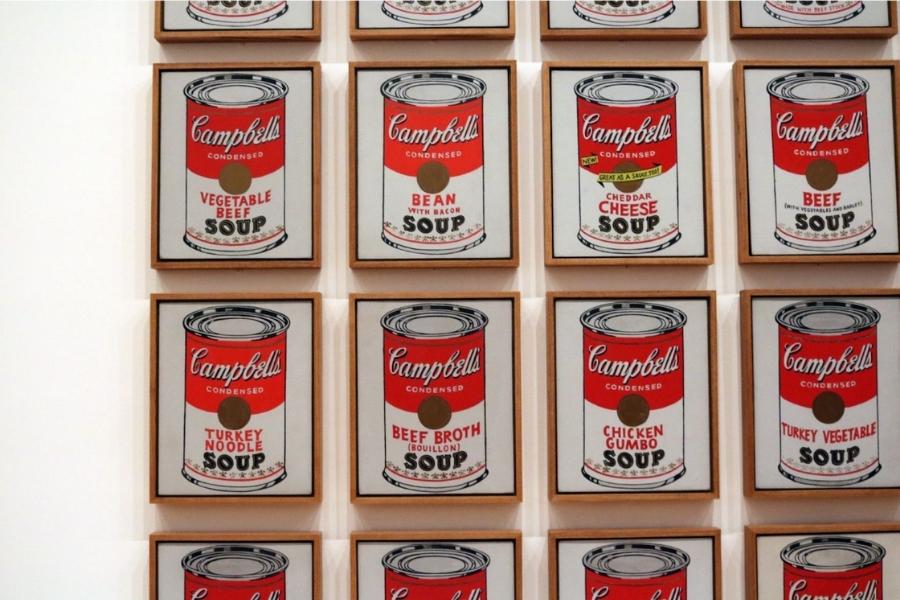
And finally, something very different. When Andy Warhol unveiled Campbell’s Soup Cans in 1962, it challenged almost everything people thought art was supposed to be. The work consists of 32 canvases, each depicting a different flavour of Campbell’s soup. At first glance, the cans look identical, but there are subtle variations in each.
At the time, the art world was dominated by emotional, expressive styles – but Warhol painted ordinary items, removed any ‘emotion’, and embraced repetition. Campbell’s Soup Cans is seen as a defining work of Pop Art, but when it was unveiled, people debated whether something mass-produced could even be art. Did art have to be unique or emotional? Or could it simply reflect the world we live in?
With this work, Warhol reflected on the rise of advertising and mass consumption in post-war America. While the paintings were initially hand-painted, he soon adopted silkscreen printing – a technique that allowed him to replicate images, mirroring the same mass production he was exploring.
What makes Campbell’s Soup Cans so powerful isn’t the image…it’s the idea behind it. Warhol took something ordinary and forced people to look at it differently – and in doing so, redefined what art could be.
Final thoughts…
Art might be largely subjective, but these works have endured because they do something extraordinary. From Renaissance masterpieces to bold modern statements, what these artworks have in common isn’t just technical skill and beauty…but their ability to leave a lasting impression.
Some capture quiet mystery, celebrate human strength and potential, and dazzle with their technical brilliance. Others move us on a deeply emotional level, question the world we live in, or portray raw emotion or political outrage.
But all of them invite us to look a little closer and think more deeply – a wonderful reminder that great art doesn’t simply hang in galleries; it stirs emotion, sparks questions, and endures for centuries.
For more inspiration, check out our article: 11 of the best art galleries to visit in the UK.
Are you particularly drawn to any of these artworks? Or do you have another famous favourite you think should have made the list? We’d love to hear from you in the comments below.
Selene Nelson is an author, freelance journalist, and lifestyle writer for Rest Less. After graduating from the University of Sussex with a degree in English Literature, Selene began contributing to many major newspapers and websites, and has written for the BBC, The Sunday Times, The Independent, Town & Country, and HuffPost. Her specialist subjects include food, travel, and health, though she enjoys writing about a wide range of topics (e.g. her two books are about veganism and psychopathy, respectively!). She enjoys cooking (particularly pasta and Asian noodle soups), reading, travelling, hiking, attempting to keep fit, and watching animal videos on YouTube.
* Links with an * by them are affiliate links which help Rest Less stay free to use as they can result in a payment or benefit to us. You can read more on how we make money here.
Join the discussion
Read our full commenting terms and guidelines