
- Home
- Leisure & Lifestyle
- Home & Garden
- 7 interior design trends for 2026
How does Rest Less make money
We make money through advertising and commission from affiliate links, which enable us to offer Rest Less as a free service to our users. The content on this page may use affiliate links, which track traffic from our website to a third party provider and enable us to receive a commission or payment from any traffic we refer.
* Affiliate links on this page have an * next to them. We place enormous importance on our editorial independence and the integrity of our content which means that we will never change how we write about something as a result of an affiliate link.
If you’re looking to change your home this year, with so many interesting new design trends, you couldn’t have picked a better time.
After years of pared-back minimalism, clean Scandinavian styling, neutral palettes, and rigid design ‘rules’, homes are getting back to being personal, comfortable, and unapologetically individual.
This isn’t a rejection of elegance or quality, but more so an evolution towards spaces that feel loved, lived-in, meaningful, and human. Perhaps it’s a small, cosy rebellion against a world that seems to be fraught with conflict and coldness?
The defining design trends of 2026 seem to reflect broader cultural shifts: a desire for authenticity, sustainability, comfort, craftsmanship, and creative freedom. Artisanal decor, tactility, softness, maximalist, and vintage touches are all making a return.
Here, we’ve pulled together seven interior design trends for 2026.
1. Colour drenching
The accent wall is making its exit this year after an illustrious stint as that pop of colour in so many rooms and homes. Taking its place is a colour trend that’s even bolder, braver, brighter, and ripe with potential.
Colour drenching involves painting an entire space – not just the walls but the ceiling, skirting, woodwork, doors, frames – everything, in one colour. It’s designed to create a captivating, cohesive, and immersive space: perfect for anyone wanting to make a statement in one room, or indeed every room.
The beauty of colour drenching is that you can choose any colour you like. You could be dramatic and daring with a red or purple, or create a dreamy, bright space with lighter creams or a duck egg blue. Browns and terracottas can also lend a beautifully warm, earthy vibe to your space, and are predicted to be a popular colour choice in 2026.
Before you commit to a colour, it can be helpful to examine the size of your space, the amount of natural light you’re working with, and the surface area you’ll be drenching. For more tips, you might find this guide to colour drenching from The Lounge Co useful.
2. Soft maximalism
Soft maximalism looks set to have its moment in 2026, as many people wave goodbye to the sleeker, harder textures and silhouettes of contemporary designs in search of cosier, more homely designs.
Soft maximalism maintains the ‘more is more’ ethos of traditional maximalism, but is a step away from excessive, densely packed collections of patterns, textures, and furnishings. Looks tend to be more curated, with fewer pieces than traditional maximalist spaces, but greater emphasis on individual pieces being a little more expressive and given the space to shine.
An inviting balance between comfort and expression, soft maximalism allows you to have fun decorating your space without feeling like it’s too much. Think thoughtful layering of textures and patterns with a few really special pieces that draw the eye, as well as a strong use of colour. In fact, it’s a design choice that works really well alongside clever colour drenching.
Soft maximalism can also be a great option for those wanting to test maximalist design without needing to go all in just yet.
3. Artistic Lighting
The importance of lighting has become increasingly elevated in recent years. And in 2026, it’s becoming an even more central design feature, as plain shades take a back seat in favour of more artistic lighting.
Sculptural lighting specifically is predicted to become an influential trend this year, with elaborate, statement designs and materials blurring the line between light and art. Think big, statement pendant lights, brightly coloured oversized floor lamps, and architectural wall sconces treated more and more as focal points, often anchoring an entire room. Materials tend to be tactile and expressive: painted silks and fabrics, hand-blown glass, patinated metals, alabaster, ceramic, and woven natural fibres.
Similarly, layered lighting is set to shine in 2026. Rather than relying on a single overhead source, layered lighting uses a mix of ambient, task, and accent lighting to create beautiful, cosy atmospheres. It’s about glow rather than glare, using light to enhance textures, highlight architectural details, and make rooms feel intimate and welcoming.
To achieve artistic lighting, it can help to choose lampshades and lighting that look as beautiful during the day as they do at night.
Check out this guide to artistic light fixtures from The Artling Artzine to learn more.
4. Biophilic design
Biophilic design was one of last year’s top interior design trends, and the popularity of bringing nature indoors doesn’t seem set to slow down. As people continue to notice the connection between their living environment and wellbeing, their appreciation for biophilic design and a more holistic approach to materials, light, and spatial flow grows.
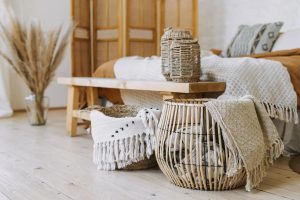
Natural materials and irregular shapes, including solid wood, stone, linens, wool, clay, cork, and rattan, are taking centre stage this year. With natural shapes and materials comes natural colours too, and many people are choosing earthy colour palettes to reinforce the connection to nature.
You might even like to combine biophilic designs with colour-drenching and soft maximalist techniques. For example, spaces drenched in warm beiges, soft browns, clay reds, moss greens, or muted blues offer the ideal backdrop to show off natural, handcrafted furnishings and plenty of well-placed houseplants.
If you plan to biophilic design into your space in 2026, remember that it’s less about decoration and more about how a space makes you feel. The idea is to create a calm space that allows you to unwind and relax. Check out our article, Bringing the outdoors in – 9 ways to use biophilic design at home, to learn more.
5. The return of craft
We’ve already seen a move away from fast fashion, with many consumers actively shunning mass-produced polyester in favour of more sustainable alternatives. And in 2026, there’s an expected shift away from fast furnishing, too, towards more bespoke, personal, and crafted pieces that are built to last.
Not only is this good for the planet, but many handcrafted pieces tend to bring a unique sense of warmth, authenticity, and soul to interiors.
Examples include bespoke joinery and carved wood, hand-thrown ceramics, woven textiles, hand-stitched lampshades, and custom metalwork. The idea is that these bespoke pieces become focal points in a room, valued for their originality, aesthetic appeal, and the skills and stories behind them.
This trend might even signal a return to furniture-as-heirloom; a hand-finished dining table or a custom-built bookshelf becoming a lasting investment rather than a disposable trend. The truth is, these individual pieces will cost more than Ikea furniture. However, you can start small with this trend, slowly collecting pieces that really speak to you and enjoying how each one changes your space in its own special way.
6. Reviving vintage
In the same vein as the move towards crafted and artisanal pieces, vintage revival is set to be big in 2026. Trips to Ikea and online shopping are being swapped for visits to auction houses and vintage furniture stores.
Many of us are becoming increasingly aware that, with some savvy shopping, you can find incredibly unique and long-lasting pieces that won’t cost much more than mass-produced furniture.
What you also get with vintage pieces is that sense of softness and shape that seems to be permeating many other 2026 trends: curves, movement, and warmth; hand-crafted over machine-made; and natural and soft over geometric and hard.
Again, this might be a response to a world that’s becoming increasingly tech-led and digital – maybe we are looking to surround ourselves with what feels more natural, more mindfully produced, and more touched by humans. It certainly opens up a world of unique and wonderfully varied design choices. To get started, why not try incorporating a few antique accents alongside the more contemporary pieces in your home to create a welcoming, interesting sense of character and heritage?
Check out Homes and Gardens’ article, How our obsession with vintage is changing the way we decorate in 2026, to learn more.
7. Reading nooks
According to Zillow’s home listings, ‘reading nooks’ are a growing trend in the homes they advertise, and might signal a new design trend for 2026. Also known as a reading corner, a reading nook is a small corner/area within a room created especially for curling up with a good book.
Founded on the idea of cosy, slow spaces that favour simple pleasures over the sheen and shine of technology and modern trappings, reading nooks pair perfectly with many other popular interior design trends.
And the good news is that it’s easy to set up a small reading nook in your home, even if you don’t have a huge amount of space to play with. A comfortable armchair, a warm blanket, a beautiful lamp and a small bookshelf can turn any corner into a mindful and relaxing space. Check out our 11 cosy reading nook ideas to get inspired.
Creating a nook of your own can also be a fantastic opportunity to try out some other interior design trends. For example, you could experiment with maximalism in a small area rather than an entire room or source some vintage, bespoke pieces to spotlight that won’t require a full room redo.
Final thoughts…
Many of the interior design trends of 2026 are centred around creating warm, cosy, personal, and expressive spaces that encourage proper rest. For many of us, this offers a welcome escape from our busy, fast-paced world and the previous emphasis on mass-produced furnishings.
That said, while interior design trends can offer inspiration, the best spaces are those that reflect your own personal style.
For further reading, head over to our home and garden section.
What do you think about this shift to a cosier, softer and more natural interior aesthetic? Do you have a reading nook, or does the idea appeal to you? We’d love to hear from you in the comments below.
Dee Murray is a freelance journalist and copywriter, and a lifestyle writer for Rest Less. After graduating from DIT Dublin with a degree in Scriptwriting and the University of Sussex with an MA in Creative Writing, Dee began writing for experience and adventure companies. She then founded Ryanair’s first travel blog, which she managed and wrote for for five years. She writes about a range of topics but most often about travel and adventure or women’s interests. She also has a keen interest in behavioural psychology, mental health, and nutrition and wellness. When she’s not writing, you can find her in the woods with her dog Boudicca, playing piano (poorly), or tending to her plants and vegetables.
* Links with an * by them are affiliate links which help Rest Less stay free to use as they can result in a payment or benefit to us. You can read more on how we make money here.
Start your new chapter abroad with this free retirement guide
With Your Overseas Home, you will receive honest guidance, expert advice and a helping hand every step of the way.
Download the free guide to find out how to cut everyday living costs, get tax, pension and visa checklists, and discover top tips from the expat community.
Join the discussion
Read our full commenting terms and guidelines