
When Primate was marketed as a pulse-pounding horror film that would have audiences jumping out of their seats, Paranormal Activity-style, I was sceptical. After all, how scary can a movie about a chimpanzee really be? It can hardly compete with the likes of axe-wielding murderers, vengeful spirits, or deranged stalkers. Or can it? Lewis Teague’s Cujo, where a friendly Saint Bernard contracts rabies and goes on a terrifying killing spree, might suggest otherwise.
Directed by British filmmaker Johannes Roberts (47 Meters Down, The First Omen), Primate is mostly shot in a single location: a secluded, elaborately-designed family home, complete with a pool, perched high on a cliff in the Hawaiian mountains. For most, this would be a tropical dream. Yet, the brutally graphic opening scene, showing a veterinarian’s fatal encounter with a frantic chimpanzee in what appears to be a research facility or zoo, shatters any illusion of safety.
The film centres around Lucy (Johnny Seqouyah), an emotionally distant college student, who warily flies home to Hawaii after her finals. Accompanied by her best friend Kate (Victoria Wyant) and frenemy Hannah (Jessica Alexander), the 21-year-old reunites with her teenage sister Erin (Gia Hunter) and her deaf, crimewriter father Adam (Oscar-winner Troy Kotsur).
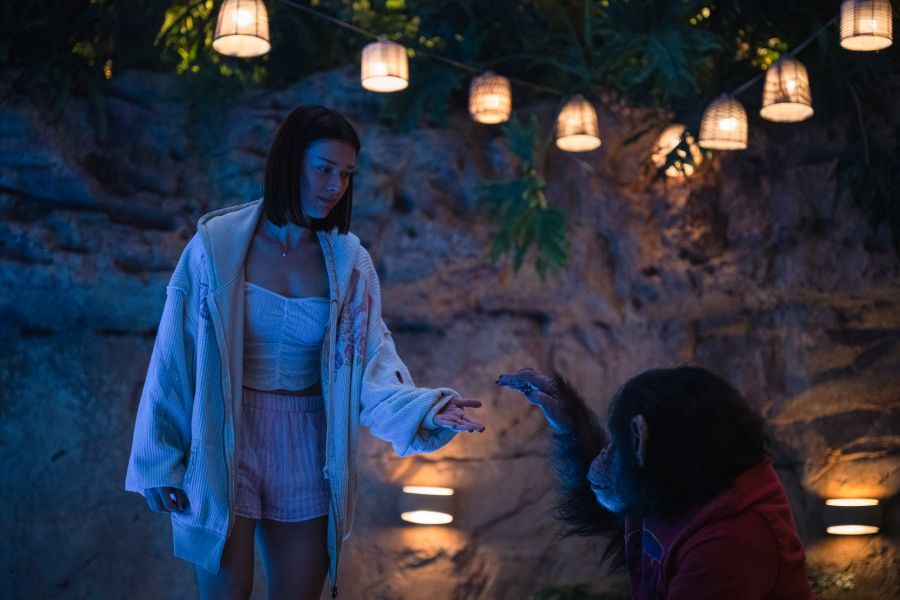
The family is mourning the loss of Lucy and Erin’s mother, a linguistics professor who is briefly mentioned to have died of cancer a year ago. She had worked with a chimpanzee named Ben, teaching him to communicate via iPad as part of her research. Gentle and docile, Ben still lives in the family home as a pet, sharing hugs and hand-holding with his human companions. Only Hannah seems uneasy around him – and after that opening scene, we know her instincts are dead-on.
Courtesy of Paramount Pictures
But, suspicion aside, alarm bells aren’t officially raised until Ben attacks Erin in a stomach-churning, hair-raising scene, confirming that the horror has truly arrived. Ben is no longer Ben; tender, heartfelt moments are replaced by a skin-peeling, head-crushing, jaw-breaking rampage that holds back nothing. And as the group frantically seeks refuge in the pool – the only place that their once-lovable, teddy-clutching Ben can’t reach – it’s clear that something has gone catastrophically wrong.
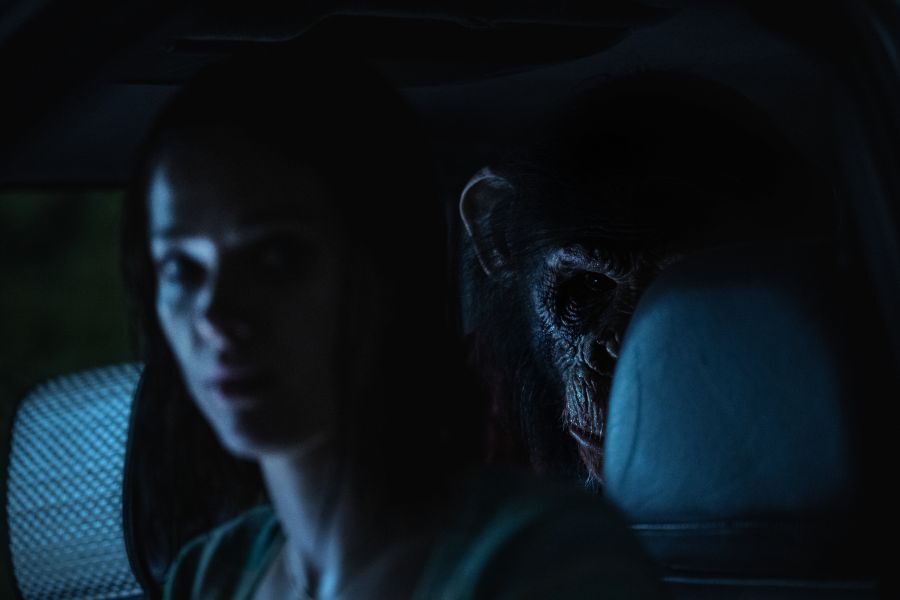
Unless you have a strong stomach, Primate certainly won’t serve as the perfect “dinner and a movie” combo. While not conventionally “scary”, it had me sliding down in my seat, covering my eyes, and mouthing, “What?!” to my friend, who was equally squeamish beside me. Why? Because Ben may be rabid, but his kills aren’t quick; they’re slow, methodical, and grisly. He stalks his victims before ripping them apart or bludgeoning them into pulp in scenes that even seasoned horror fans might struggle with.
At a lean, mean 89 minutes, Roberts refuses to let you relax until the credits roll, with discomfort being the only item on the menu. The one-location premise could have felt limiting, but the film uses it to its advantage, maintaining relentless forward momentum as the characters fight tooth and nail to survive, reach the outside world, and escape their nightmare. The sequences featuring Lucy’s father are especially unsettling. Much like Hush and A Quiet Place, silence amplifies the dread as we watch him, unable to hear the chimp stalking closer.
Speaking to The Gate, Roberts said, “In these kinds of movies, you put people in a single, inescapable situation and see how they react. As a storyteller, I love being tested, and figuring out a location, what they have to fight against, and how they’re going to do it is both for me and for an audience.”
Courtesy of Paramount Pictures
However, while Primate definitely succeeds at achieving “old-school horror” status, it does have its pitfalls. The characters remain frustratingly underdeveloped; we learn little about their lives or motivations, giving the film a hollow feel once you strip away the terror. But the cast puts on a good show, selling the fear convincingly and throwing themselves into the physical and emotional demands of their role, while still, at times, acting dumb enough that you’ll be shouting at the screen in frustration, vouching for their survival.
For understandable safety and ethical reasons, the film also doesn’t feature a real adult chimp, but rather an actor (Miguel Torres Umba) in a suit. This choice arguably amplifies the scares, giving the team creative license to make Ben’s attacks as barbaric as possible, though it does sacrifice some realism – an actual chimp’s behaviour would probably look quite different from what’s depicted here.
That said, the effect on set was clearly visceral. Sequoyah told Variety, “Ben comprises a 50-person ‘chimp team,’ and he was really scary. When he’s on top of you, your body doesn’t know what’s real or not. I walked off some takes uncontrollably shaking.”
But beyond the movie magic, the threat is very real. Adult chimpanzees are four times stronger than humans, with their aggression well-documented. The fact that people have actually kept them as pets – and been attacked by them – gives the film’s gruesomeness a disturbing real-world foundation, even if Ben’s specific behaviour is exaggerated for effect.
Ultimately, Primate is a chilling reminder of the power of nature and what happens when someone you love turns against you. It won’t satisfy those craving depth or nuance. But as pure, primal horror? It’s absolutely savage.
Primate is now showing in UK cinemas.
Banner image: Courtesy of Paramount Pictures