
- Home
- Leisure & Lifestyle
- Writers Corner
- Cucumber Sandwiches
How does Rest Less make money
We make money through advertising and commission from affiliate links, which enable us to offer Rest Less as a free service to our users. The content on this page may use affiliate links, which track traffic from our website to a third party provider and enable us to receive a commission or payment from any traffic we refer.
* Affiliate links on this page have an * next to them. We place enormous importance on our editorial independence and the integrity of our content which means that we will never change how we write about something as a result of an affiliate link.
Creative writing submission from the Rest Less community – submit your entry here.
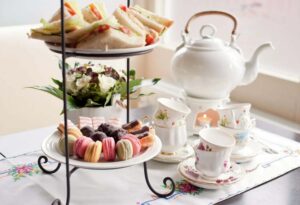
Readers may remember that my husband and I were invited to Colonel Saab’s in High Holborn, London, for a sumptuous Indian afternoon tea. Afternoon tea has definitely become a thing – a real destination event with every restaurant and hotel worth its cucumber sandwiches buying fancy teapots, vintage china and setting out their offerings.
In fact, when my husband and I were invited to Warner Hotels at Heythrop Park in the Cotswolds, their afternoon tea was definitely on the agenda. Yum yum – it was wonderful. I can’t tell you how many times the teapot was refilled. But did you know that afternoon tea is very much not a new idea?
Back in the 50s and 60s, my dad had a blouse manufacturing business, and every Sunday, Mum, Dad, my sister Nadine, baby brother Paul and I would get in the car and we’d drive from North London down to the Serpentine in Hyde Park. We’d park up and have a lovely leisurely walk alongside the Serpentine before walking back and having a mooch down Bond Street.
Jam-packed with luxury fashion shops, we’d stop in front of any design in the window that caught his fancy. There was no ‘taking a quick picture’ then. Dad would make a quick shorthand sort of sketch to note the salient details, so, at work, he could turn the latest fashion into a mass market blouse to be sold in Dorothy Perkins or Etams.
And after we’d finished in Bond Street, it was off to the nearest J. Lyons Corner House – one of their flagship stores in Tottenham Court Road. Oh, how we looked forward to that wonderful afternoon tea ceremony.
The Beginning: Salmon & Gluckstein
It was 1843 when Samuel, eventual founder of Salmon & Gluckstein tobacco merchants, left his family to seek his fortune and send for the remainder of his family once he had made it. He’d been told he’d find lodgings in Whitechapel, and handing over his rent, he now had somewhere to live.
Samuel loved to smoke and purchased a small quantity of dried tobacco from the local docks, and attempted to make cigars. He practised for hours to get the rolling just right – too loose and the tobacco fell out, too tight and the cigar wouldn’t burn. Inevitably, working such long hours, he fell ill, and unable to call for help, he languished in his bed, unable to either eat or drink.
Luckily, the landlord’s daughter, Ann, heard a feeble cry for help. Samuel survived under Ann’s ministrations and, two years later, they were married and successful. It was now time for Samuel to send his family money so that they could all join him in a larger flat in Whitechapel. Samuel employed his three younger brothers in his fledgling tobacco business, which meant he could concentrate on buying the raw materials – tobacco leaf from West Virginia.
Samuel’s growing family now employed his eldest son, Monte, and it was he who opened a series of individual tobacconists’ shops all over London to sell their own hand-rolled cigars.
They soon branched out into smoking accessories – beautiful and unusual pipes, for instance. Lena (Monte’s sister) concentrated on obtaining all manner of goods from around the world, whilst Monte was busy sourcing all the different kinds of cigars he was constantly being asked for, as well as selling loose tobacco.
Monte, ever the entrepreneur, came up with a wonderful advertising gimmick – surely the forerunner of all the loyalty card schemes we are so used to now – whereupon once a customer purchased a set number of products, the next was free!
In 1887, Monte was the head of the family and was casting around for new business propositions. As a travelling salesman, he had been appalled at the general standard of bought food and even more at the lack of “nice” drinks for women outside the home.
Thinking back to the Great Exhibition of 1851 – or the ‘Crystal Palace’ – Monte called a family meeting and declared that they would be going into “catering”. Like the rest of his family, Monte was a teetotaler, and since there was a growing movement among wives everywhere who were fed up with their husbands’ wages being drank away before they brought the money home, Monte was sure this would be a winning business.
But his brother-in-law was deeply sceptical. They were already successful, so why diversify? After a long discussion, they agreed to compromise. Monte could continue with his catering plan as long as he used a different company name, so he immediately thought of a relative from his extended family. Personable, something of a showman, but more importantly, he had an English name – Joseph Lyons.
Glamour and exhibitions
And so the deal was done. Joe Lyons would provide the name, whilst Monte’s Salmon & Gluckstein would provide the expertise and, more importantly, the money. All of this was immortalised on a single sheet of paper at the cost of one shilling!
Monte set out to obtain the contract for the Royal Mining Engineering Jubilee Exhibition in Newcastle, and it was May 1887 when the pair stood nervously waiting for the Duke of Cambridge to declare the place open. And as the Duke did so, the duo raced off to open the refreshment area.
Monte and Joe had gone to town with the décor. There were Chinese decorations with red lanterns, orange streamers and dragon-embroidered chairs. The second floor had an Indian theme. The refreshment area was overwhelmed with customers, and people were standing in long lines (even then, the British loved a queue!).
Tea and cakes were priced at a very low three pence rather than the more usual eight pence, and there was a Hungarian orchestra to keep everyone entertained whilst they queued and ate. Then, alongside the tea rooms was a shooting range which proved very popular.
Following a family conference, it was unanimously decided that Monte should concentrate on his catering empire. Over the next few years, he became known as the “right man for the job” as he won contract after contract in this increasingly lucrative area.
And then Barnum & Bailey advertised The Greatest Show on Earth, and after weeks of negotiations, Monte managed to secure the catering deal. It was to be an enormous gamble for the company, since the venue – The Grand Hall at Kensington – had few facilities.
Working day and night, eventually The Greatest Show on Earth opened on November 11th 1889, and Monte’s optimism was rewarded. With cafes and eating stops dotted around the hall and two 20-minute pauses between entertainment, by the end of the year, J. Lyons had served over three million visitors.
Ambitious Monte had been carefully watching the way Barnum & Bailey had drawn in the public with spectacle, glitz and glamour. So, when the greatest show ended, Monte made a pitch. Putting his ideas to the family fund for a vote, he was empowered to make a successful bid, and his first idea was to bring “Venice to London”.
On 26 December 1891, Venice opened. During all the building work, Monte had even travelled to Venice and bought 40 gondolas whilst procuring the services of a squad of gondoliers. It was an immediate success. Over that year, Venice attracted over four and a half million visitors. And when Venice began to pall, Constantinople was to be next, following a chance remark by the Prince of Wales.
With Constantinople scheduled to open just after Christmas 1893, Monte employed more than 2,500 workmen, paid for more than £60,000 in advertising (over six million in today’s money), and built the Bosphorus waterway. And the public couldn’t get enough.
But Monte wasn’t satisfied since there were loads of other companies now all determined to beat him at his own game. Monte had decided that he wanted permanent venues across the country, all with the Joe Lyons logo, to capitalise on their hard work, expertise and growing reputation.
And so in 1894, the company took an expensive lease on 213 Piccadilly, which was to be their very first permanent teashop. After the sumptuous renovation, a signwriter was paid £15 to paint the outside in white gloss with J. Lyons in large gold letters on the front.
Monte had made the teashop trade respectable and was convinced that this was an ideal job for young female employees. The company were inundated with applications. And with his no-alcohol policy and a set-aside woman-only space, the shop was a huge success.
A second shop in Victoria soon followed, and over the next six months, more were added. The shops had been buying their food in, until with the purchase of what became Cadby Hall, Joe Lyons began to cook everything in-house.
Such rapid expansion required a huge amount of capital, and Monte resolved to take the company public. Not wanting to lose control, he created two types of shares: “A” shares, which had no voting rights and “B” shares, which the family held and obviously could use to vote.
Remember the Trocadero? J. Lyons quietly bought that in 1894, although it brought a precariousness to the company’s wealth. After demolishing the existing structure, he hired an architect to design a 2,000 square-metre building incorporating a state-of-the-art restaurant and bar. And on October 1st, 1896, the family – dressed up to the nines, along with a large group of well-known celebrities – attended the Trocadero opening.
It was in December 1901, with Salmon & Gluckstein, who was now the country’s largest retail tobacconists with over 160 shops, that Monte persuaded the firm to sell to Imperial Tobacco Company for £400,000 (41 million in today’s money). The Family were now extremely wealthy.
The birth of The Corner House
Just before the First World War in 1909, with the Trocadero for the upper classes and the tea shop for the working man, the question Monte posed was, “What about the middle classes?”
And so The Corner House was born – a single building where the middle classes could eat, shop and even purchase theatre tickets. Its purpose was to provide an array of shops and restaurants that could cater to everyone at different times of the day.
Since the building was in the heart of theatre land, a meal before a matinee was a particular requirement. And on January 3rd, 1909, with a long line of would-be visitors queuing around the block, the very first Corner House opened.
Inside were all kinds of different shops selling chocolate, cheese, and cooked meats. There was even a shoe-shine stall, a hairdresser and a telephone kiosk. And that’s not to forget about the array of restaurants – a grill, a bar and of course a teashop.
Yet another surefire success. And two more Corner Houses swiftly followed.
And there we will leave it – with a 10-year-old Janet enjoying a birthday tea party at the Oxford Street Corner House. During my “looking for a husband” years, the Corner House would play an impressive part in my romantic history. Who could forget sitting at a table with a romantic date, watching the chef in his open-plan kitchen, cooking bacon and eggs before your very eyes?
The Corner House was really some institution.
Are you feeling creative? We are proud to have a hugely talented community on Rest Less, which is why we’re so excited to open up a section of the site dedicated to showcasing the wonderful and diverse writing of our members. If you have a piece of creative writing that you’d like to share with the Rest Less community – you can do so here.
Having edited and written features for all kinds of magazines, Janet, now 77, has sort of retired. Living on the Herts/Essex border, near Hatfield Forest, her house has thousands of books crammed in everywhere. Left handed Janet has also learnt to crochet, and if you’re (un)lucky, you’ll be given one of her massive multi coloured throws which apparently is all she can crochet. She also stalks supermarket book aisles spying on readers’ choices whilst operating an unofficial library for friends and families. Busy sleuthing dog friendly UK holidays, her proudest boast is that she was taught to drive by F1 champion Graham Hill.
* Links with an * by them are affiliate links which help Rest Less stay free to use as they can result in a payment or benefit to us. You can read more on how we make money here.
Join the discussion
Read our full commenting terms and guidelines