
- Home
- Leisure & Lifestyle
- Writers Corner
- Lamu Island, 40 Years On: Looking Back on a Trip to the ‘Kathmandu of Africa’
How does Rest Less make money
We make money through advertising and commission from affiliate links, which enable us to offer Rest Less as a free service to our users. The content on this page may use affiliate links, which track traffic from our website to a third party provider and enable us to receive a commission or payment from any traffic we refer.
* Affiliate links on this page have an * next to them. We place enormous importance on our editorial independence and the integrity of our content which means that we will never change how we write about something as a result of an affiliate link.
Creative writing submission from the Rest Less community – submit your entry here.
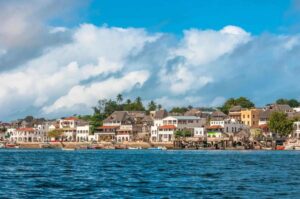
Our instructions were to head for the fish restaurant on Lamu waterfront and ask for Ghai, who was an imposing bulk of a man clad in a khaki suit and wearing leather flip-flops. He wished us well but shrugged. Sorry, no spare rooms. He waved a hand along the sandy track beyond the 25-metre tarmac strip where we had landed off the ferry boat, at the same time making up for the no rooms situation by inviting us back for dinner that same evening. It was there that I ate my first fresh lobster, on the Lamu waterfront beneath a starry African sky.
We had spent the previous 48 hours travelling up the coast from Mombasa. Our out-of-date guidebook had led us along an unplanned detour around an estuary. We drove through the red dust and mud huts of Giriami country. I was at the wheel, rally driver style, as I tried to navigate the troughs and gullies of an African backcountry dirt track. We just made the 19-mile detour through villages of mud huts and staring women unused to seeing any strangers, let alone two travellers in mechanised vehicles.
I turned the hire car back onto the coast road, heading for an overnight comfort stop at Kilifi before pressing on to Lamu Island. The car was not handling properly. I pulled over and got out. Sure enough, our hire car was listing to one side, the passenger front tyre gently resting on the rim of the wheel hub. We had a puncture. On the plus side, we were not in the middle of the backcountry. L, my partner, had already got the boot open. He looked up at me and shook his head.
“Nothing. No spare tyre.”
“Oh.”
We stood and looked at each other for a while.
A local happened by on his bicycle. “Hey, is something a problem?”
“Yes, we’ve got a puncture and no spare tyre.”
The local man sucked his teeth.
“Okay, okay. I’ll give you a lift to the garage. But first, let’s get this broken tyre off so we can take it with us.”
L and our new friend took the punctured tyre off and left the car on the jack for the time being.
“Okay, you stay with the car for now,” I said. Uncharacteristically, I was content for L to take charge. He straddled the luggage rack so as to ride pillion on the bicycle. I passed him the old tyre and watched as they wobbled down the road towards Kalifi and the garage, L’s legs outstretched on either side for balance.
One hour later, a small pickup truck pulled in front of our hire car. L stepped out with the garage owner.
“He’s going to try to repair the tyre,” said L.
“I’ll do my level best,” said the mechanic.
I nodded.
“Let’s get you along to my garage now.”
Fifteen minutes later, the hire car was hooked to the pickup truck so it could be towed on its two rear wheels. We were squashed into the front passenger seat of the truck, sharing a seat belt.
As it turned out, the garage was minus a tyre pressure gauge. Our mechanic’s intention to do his level best was welcome but sadly misguided. Every time he inflated the patched-up tyre, the patch would pop off again. It was just past midnight when we thanked him profusely for his efforts, paid him for his time and arranged to leave the hire car at Kalifi police station early the next morning.
From Kalifi northwards to Lamu Island, we bounced and banged most of the way on a bashed-up Leyland bus with no suspension, squashed between a breastfeeding mother and a crate of chickens. Our only relief was when the driver called ‘everybody out’ and we all lent a hand to pull the ropes, which propelled the wooden ferry across the river. The last leg of the journey was by a wooden foot ferry across the narrow strait that separated Lamu from the mainland.
Within an hour of setting foot on the island, we were lying back on the balcony of Kisiwani Lodge. I closed my eyes. The only sounds were the hollow slap of waves against the wooden dhows moored below and the singing of cicadas.
Two 10-year-old boys interrupted my reverie.
“Here she comes, look!”
They explained in breathless unison how men and boys weren’t allowed to look at the bride before a wedding, who was at the centre of a crowd of women in black chadors, their eyes shining in the darkness.
The concealment of women in public was a long-held tradition in Lamu. Travellers in the 19th century would have seen women walking the streets in shiras, portable tents supported on four wooden poles carried by slaves. If the traveller happened to be a man, he would have been required to stop and turn towards the wall until the shira had passed out of sight.
The insistent beat of a ceremonial drum accompanied the procession on its way through the narrow alleyways of the old town. As the drum beat grew fainter, we exited our lodge and headed for Petley’s Inn, one of the few places licensed to sell alcohol on the whole island. Here, we discovered how Kenyan civil servants, posted to Lamu, survive the long separation from their loved ones.
The island woke up at dawn. The old town is one of the oldest and best-preserved Swahili settlements in Africa, and a UNESCO World Heritage Site. I threw cold water over myself in the stone-floored bathroom, dressed and climbed the stairs to the roof. At the edge of the waterfront below, a lone fisherman was bailing out his dhow. His legs were wrapped in a faded blue cotton dhoti, and his cracked feet wore the rubber sandals which have made Bata a household name across Africa.
We had agreed that today we would search out our island paradise. We would sip coconut milk under palm trees, ocean waves lapping at our feet. I had consulted the backpacker’s guide and determined that the only place on the island remotely resembling our Bounty advert vision was Peponi’s, a small, white hotel on the promontory where the Indian Ocean crashed towards the sand dunes. The small but well-stocked bar was and is a popular stop on the way to the beach, as well as the pickup point for dhows back to town.
Fortified by a generous breakfast of pancakes, fresh fruit and milky coffee at the Yoghurt Inn, we headed out, deciding to walk to the hotel and the beach. Outside one of the magnificent carved doors found everywhere in the island’s traditional Arab houses, a group of children were jostling each other for a ringside view. I was puzzled at first by the wooden cart full of silver cases. Then I noticed the children in more detail. They all sported blue and white badges. The Blue Peter TV crew were in town!
We took refuge in Kenya Cold Drinks behind the museum. Over tea and samosas, we chatted to an American Peace Corps worker about solar power and travelling light. She introduced us to the Captain and his right-hand man, who went by the name of Bob Marley. At last, we had struck gold. The Captain was taking his dhow out for a full moon fishing trip the next day at midnight. We signed up there and then.
The bows of our wooden dhow parted inky waters. The moon trailed a silver pathway behind us. The pile of gleaming blue and yellow fish on deck grew higher. Bob Marley dropped anchor. I slipped over the side of the dhow and swam ashore. The aroma of our BBQ supper, skewered on sticks, drifted through the open doorway of the wooden shack. We cracked a few bottles of Tusker lager. The conversation turned from Indian films to swimming by moonlight. A pleasant drowsiness overcame me.
Then I spotted the blue and white piece of plastic pinned to Bob Marley’s striped rasta hat. The Blue Peter crew had struck again! No matter. The Captain passed me another bottle of Tusker, and I knew in my bones that one day I would return.
Are you feeling creative? We are proud to have a hugely talented community on Rest Less, which is why we’re so excited to open up a section of the site dedicated to showcasing the wonderful and diverse writing of our members. If you have a piece of creative writing that you’d like to share with the Rest Less community – you can do so here.
Growing up in East London, Anne has written stories since she could hold a pencil. Her early career was in lecturing, health education and feature writing, before co-authoring and editing professional publications at a think tank. She has worked with MPs, peers in the House of Lords and members of the European Parliament with the aim of improving children’s futures. Anne continues her learning through her travels across four – soon to be five – continents, which she shares on her Substack page @somewhereexoticwithfruit.
* Links with an * by them are affiliate links which help Rest Less stay free to use as they can result in a payment or benefit to us. You can read more on how we make money here.
Join the discussion
Read our full commenting terms and guidelines