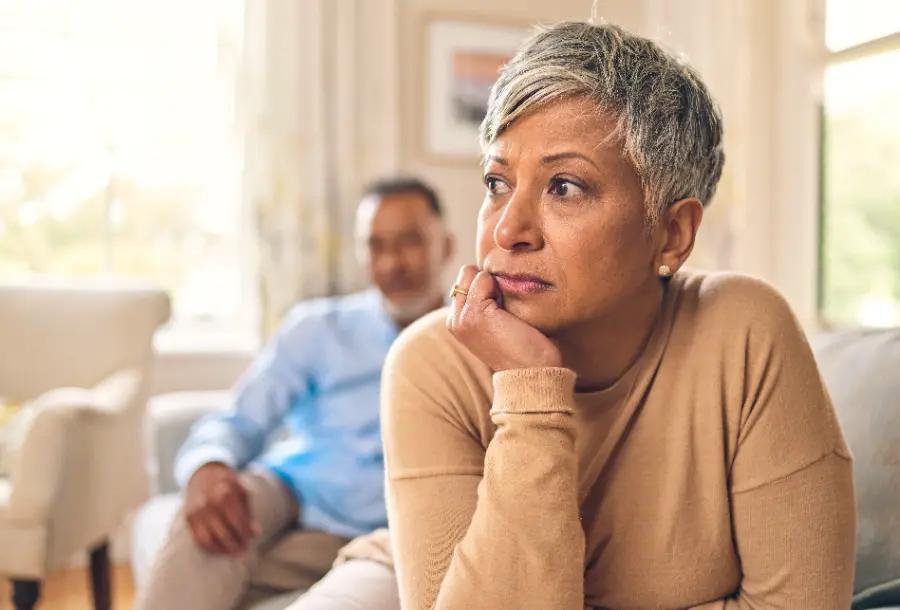
It’s no secret that many marriages don’t make it to “til death do us part”. In the UK, around 42% of marriages end in divorce, and there’s a common assumption that these splits usually happen early on. Divorces are often attributed to young couples growing apart, the stresses of raising children, or the infamous ‘eight-year itch’. But the reality is far more nuanced.

While overall UK divorce rates have fallen, older age groups are the clear exception. While the 40-44 age bracket sees the highest number of divorces, the over-50s are the only group with divorce rates that are consistently rising.

In 1990, less than 9% of divorces involved people aged 50 and over – yet by 2019, that figure had quadrupled to 36%. The surge in later-life divorces has been so pronounced that it’s given rise to a new term: ‘grey divorce.’

So why are so many couples – often after spending decades together – calling it quits? What do these divorce rates tell us about the evolving expectations of marriage? And how do you begin to navigate life as a single person after decades of partnership? Let’s take a closer look at the rise of ‘grey divorce’.

The role of rising life expectancy in divorce rates

The rise of later-life divorce hasn’t happened overnight. Experts point to several long-term changes that have converged over time. The first is that people are living longer than before. So, today, if someone is unhappily married at 50, it may realistically mean staying in that unhappy union for another 30 or 40 years. For many people, this raises an unavoidable question: “Is this really how I want to spend the rest of my life?”

The rise of later-life divorce isn’t exclusive to the West; it’s happening globally. Japan and Korea, countries with some of the world’s longest life expectancies, have also seen a surge in later-life divorces. An old Korean expression says that a marriage should last “until black hair becomes the roots of green onions”, meaning it should be a lifelong commitment. But over the past two decades, more Koreans have been going through so-called hwang-hon divorce (twilight divorces) to end unfulfilling marriages.

Japan has also seen a rise in “mature” divorces since 1990, and these now account for around 22% of all splits. Given an average life expectancy of around 87–88 years for Japanese women, and 81–82 for men, starting again in your 50s and 60s is increasingly seen as a new beginning. While life expectancy is lower in the UK (around 83 years for women and 79 for men), the same principle applies. The idea of staying in an unhappy marriage when leaving is an option is deeply unappealing.

The role of rising life expectancy in divorce rates

Starting again later in life: 10 essential steps to help you plan for divorce

If you’re feeling uncertain and overwhelmed about what comes next, a pre-divorce checklist can help you stay organised and in control, helping you approach the future with greater confidence.

In this free 10-point guide, England & Derbyshire Solicitors share 10 essential steps to help you plan for divorce thoughtfully, covering the emotional, legal and financial considerations that matter most.
Download now

Shifting societal expectations have impacted divorce rates, too

At the same time, societal expectations around marriage have shifted dramatically. In previous generations, people were often raised to view marriage as a mostly practical arrangement – a union defined by duty, financial stability, and social norms. Couples were expected to marry, have children, and grow old together, regardless of personal satisfaction. Things like emotional connection, companionship, or personal growth were often secondary considerations.

But today, things are different. People expect their marriages to provide emotional support, fulfilment, and development opportunities. When these aspects disappear – or perhaps never existed in the first place – the idea of staying together “for the sake of it” can feel increasingly difficult to justify. People are realising that there’s no one-size-fits-all path for a happy life, and this has created more choices, including the possibility of ending a marriage that no longer serves you.

The fact that women have far more freedom and financial independence than previous generations has dramatically reshaped the landscape, too. Many women over 50 have careers, pensions, and personal savings, giving them the financial security to make decisions that might once have seemed unimaginable. Most divorces are initiated by women, especially in later-life.

Women in particular are also waking up to the reality that marriage – particularly later in life – often involves a great deal of caregiving. While people are living longer, for many over 50, this means living in poor health and often dealing with chronic conditions. If you’re already unhappy in your marriage, the idea of continuing to live with your partner “in sickness and in health” can feel overwhelming.

Shifting societal expectations have impacted divorce rates, too

Exploring the personal triggers for later-life divorce

So what actually triggers later-life divorce? Unlike splits among younger couples, these divorces are rarely dramatic or impulsive. They usually follow years – sometimes decades – of quiet dissatisfaction. And, of course, people change over time, which can cause couples to drift apart and eventually choose to separate. In fact, this gradual evolution is often the main reason behind ‘grey divorce,’ rather than a single defining event, like an affair.

Many couples end up operating more like housemates than partners, held together by routine rather than intimacy. Busy years spent raising children, paying mortgages, and building careers leave little room for reflection, connection, and closeness. But often, it’s only when life finally slows down that the cracks become impossible to ignore.

The so-called “empty nest” often acts as a turning point. When children leave home, some couples realise they have little in common outside of parenting. Marriages that revolved around child-rearing can show old incompatibilities once that focus disappears. Even without overt conflict, couples may simply notice they share little beyond a history.

Retirement can be another catalyst, suddenly thrusting couples into close quarters after years of living largely parallel lives. Losing work identity or purpose can increase tension or resentment, and what once felt manageable with space and distraction can suddenly feel stifling, or even unbearable.

Sometimes, though, change comes from something more acute: the illness or death of a parent, or a health scare that forces a rethink of priorities. These moments often sharpen our awareness of time and ignite a desire to live authentically while there’s still the chance. For many, it becomes a moment of reckoning: if not now, when?

Exploring the personal triggers for later-life divorce

The unique grief of later-life divorce

While it’s clear that later-life divorce can ultimately be a positive, even liberating step, that’s not to say it doesn’t come with very real difficulties. Divorce is difficult at any age, but it can be particularly challenging later in life. Even if both parties agree on the split, there’s often overwhelming grief – not just for the relationship, but for future plans: shared retirement plans, travel dreams, and the assumption of growing old together.

The longer you’re with someone, the more difficult it can be to disentangle your lives – and ending a long marriage can feel like dismantling your whole identity. You may suddenly realise how much of your sense of self was wrapped around being a partner, someone’s wife or husband; someone’s “other half.” When that role falls away, a painful question can surface: Who are you now?

Divorce in later life is often compared to becoming widowed. When a long partnership ends, even if the separation is amicable, there can be a deep sense of loss. Something inside you fractures, and the future you imagined is irrevocably altered. Research suggests that moving on from divorce can be more difficult later in life, too. Younger people typically recover more quickly, while older adults can take up to four years to regain their footing. The silence of an empty house can feel very different at 60 than it did at 30 or 40.

The unique grief of later-life divorce

Other difficulties of later-life divorce

Later-life divorce can also bring a host of practical challenges. While divorce has economic impacts at any age, the financial consequences can be particularly significant later in life. Many couples have spent years saving for a shared retirement, and when those plans are upended by divorce, both parties may be left with far less than they anticipated. Dividing financial resources, properties, and possessions can be complex and stressful, while legal fees can quickly add further strain.

If you have children, there can be unexpected challenges there, too. When people talk about the impact of divorce on children, the focus is usually on younger ones. But adult children, who are often assumed to be “fine,” can be deeply affected as well. Many feel shocked or even betrayed by the sudden rupture of what they believed was a stable, happy family.

Research shows that adult children often feel stuck in the middle during a divorce. Some respond by distancing themselves, or even cutting contact with one parent altogether. In fact, one study found that 7% of parents lost contact with at least one child following a later-life split. But, it’s important to remember that while things can be strained at first, many children eventually come to understand and support a divorce, especially if it leads to a parent becoming happier, healthier, and more fulfilled.

Starting over after 50 – what it really looks like

So if you’re dealing with a later-life divorce, how do you begin to move on? What does “starting over” at 50 or 60 really look like?

Ultimately, it doesn’t mean you need to reinvent yourself. You don’t need to pack a bag and travel the world to “find yourself”. Instead, it means giving yourself time to recover, relying on family and friends for support, and carving out the space to ask yourself what you actually want from life – not what’s expected of you.

If you feel you might have lost touch with parts of yourself during your marriage – or that important parts of your life were set aside – why not try to rediscover them? This might mean revisiting old hobbies, and experimenting with new ones. Try to reconnect with old friendships you thought were lost. And don’t be afraid to make new ones.

Setting boundaries is also key – both with your ex-partner and any potential new relationships. If you choose to start dating again, try to be clear about your boundaries from the start, stay aware of your needs, and be less willing to settle.

If the idea of dating seems completely unfathomable, that’s okay, too. It’s normal to feel grief, anger, and bitterness. And for many people, learning how to navigate these complex emotions and move forward is where the fulfilment comes from, not from rushing into a new relationship.

Starting again later in life: 10 essential steps to help you plan for divorce

If you’re feeling uncertain and overwhelmed about what comes next, a pre-divorce checklist can help you stay organised and in control, helping you approach the future with greater confidence.

In this free 10-point guide, England & Derbyshire Solicitors share 10 essential steps to help you plan for divorce thoughtfully, covering the emotional, legal and financial considerations that matter most.
Download now

Final thoughts…

Later-life divorce can feel frightening and overwhelming, but it can also be an opportunity for renewal and self-discovery. If you’re struggling to come to terms with a divorce, it may help to look at it from a different perspective. 

Ending a long marriage doesn’t erase what came before. It doesn’t undo shared memories or diminish the life you’ve built together. Instead, it opens the door to a new chapter, one shaped by your own choices, desires, and happiness.

It also offers the chance to reclaim your autonomy, rediscover passions that may have been put aside, and create a life that truly reflects who you are. And divorce itself doesn’t have to be viewed as a failure; often, it’s simply an acknowledgement that people change over time, and sometimes, they change in different directions.

Have you experienced a later-life divorce? If so, we’d love to hear your story. Any insights or advice you’d like to share may help others on the same path, so please join the conversation in the comments below.