

- Home
- Health
- Healthy Mind
- 5 ways to practise self-compassion
How does Rest Less make money
We make money through advertising and commission from affiliate links, which enable us to offer Rest Less as a free service to our users. The content on this page may use affiliate links, which track traffic from our website to a third party provider and enable us to receive a commission or payment from any traffic we refer.
* Affiliate links on this page have an * next to them. We place enormous importance on our editorial independence and the integrity of our content which means that we will never change how we write about something as a result of an affiliate link.
In a world where we often place a lot of pressure and expectation on ourselves, developing the skill of self-compassion is important. Self-compassion is more than just a buzzword; it’s a way of treating yourself with the same kindness and care that you’d offer to others.
Research suggests that learning to have more compassion for yourself offers many benefits, both for physical and mental health – but what does this look like in practice?
Here, we’ll take a closer look at self-compassion and explore five ways to start practising it.
What is self-compassion?

The word compassion is derived from the Latin for “to suffer together.” It involves having deep awareness of another person’s suffering and a desire to help alleviate it. Seeing someone going through a tough time and wanting to help them feel better by offering a hug or words of encouragement is an example of compassion.
Self-compassion is when you direct this approach towards yourself, treating yourself with the same kindness and understanding that you’d offer others.
Learning self-compassion allows us to navigate life’s challenges with a gentler, more graceful attitude towards ourselves. Instead of being hard on yourself, you treat yourself with kindness and care.
What are the benefits of self-compassion?

While it might not always feel natural, practising self-compassion can be a great way to boost your health, improve your relationships, and navigate life’s challenges more smoothly.
As with any other skill, it can take time to develop self-compassion. But over time, you may begin to notice its benefits. We’ll cover some of the main benefits below.
Self-compassion may improve mental wellbeing
According to experts at the meditation and sleep app, Calm, you’re more likely to feel happier and more content when you’re kind to yourself.
For example, studies suggest that self-compassion can help to reduce stress, anxiety, and sadness. It’s even been linked to improved outcomes for people with post-traumatic stress disorder (PTSD).
Self-compassion may boost optimism and personal developmen
Self-compassion can help us to see the positive side of things rather than the negative. For example, you may be more inclined to see mistakes and challenges not as failures, but as opportunities to grow and develop.
As a result, adopting a more optimistic outlook on life may encourage you to be more open to new experiences.
Self-compassion may boost physical health
There’s evidence that self-compassion can be good for physical health. Experts are currently unsure why this is, but it’s thought to be the result of self-compassion leading people to make healthier lifestyle choices.
Showing yourself compassion encourages self-care because it’s deserved, not because of pressure to meet societal standards.
Self-compassion may build resistance
Life is not always smooth sailing. But being able to show yourself compassion through life’s ups and downs can make bumps along the way easier to handle.
Experts say that being compassionate and allowing yourself space and time to navigate life’s challenges can also, over time, build resilience.
Self-compassion may improve relationships
When we practise self-compassion, we’re likely to develop a deeper understanding, empathy, and patience for ourselves. When this spills over into your relationships with others, it’s likely to improve the quality and depth of your connections and interactions.
5 ways to practise self-compassion
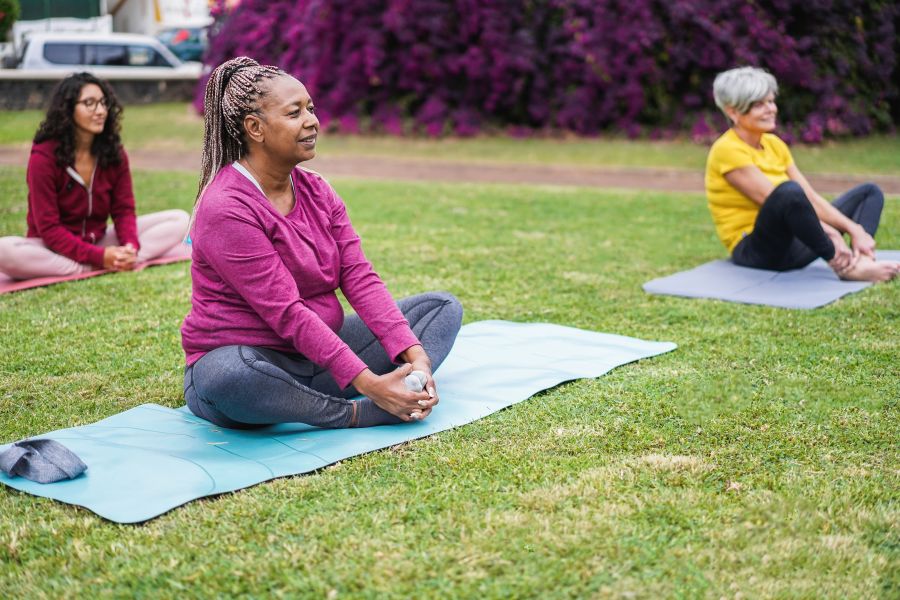
So now we know the benefits of being self-compassionate, what does this look like in practice? We’ll cover some practical ways to develop the skill of self-compassion.
1. Try mindfulness
Mindfulness works by helping you focus on the present moment. Among other things, it’s thought to benefit physical and mental health by helping to combat stress, improving self-awareness, and encouraging self-compassion.
For example, being mindful can help you become more aware of self-critical thoughts, allowing you to respond with compassion rather than judgement.
To get started, you might like to read our guide to mindfulness.
2. Approach yourself as you would a friend
One of the most straightforward ways to practise self-compassion is to approach yourself as you would a friend. While this is easier said than done, it tends to feel more natural over time.
For example, during challenges, or when you feel the urge to be hard on yourself, it can be helpful to pause and ask yourself questions like: “What supportive words would I say to my friend in this situation?” and “How would I offer them comfort?” With that in mind, remind yourself that you deserve to be shown that same level of compassion and kindness.
3. Practise using self-affirmations
Self-affirmations are positive statements that you repeat to yourself. They can be used to help change your mindset, gain control over your thoughts, and improve self-esteem.
An example is telling yourself that you deserve to be shown kindness and compassion or that you’re strong and beautiful. Even if you don’t believe the words to start with, the more you repeat them, the more likely you are to begin to accept them.
Check out our guide to self-affirmations if you’d like to get started. While written in the context of looking for love, it contains affirmations we can all practise, whether or not we’re seeking a relationship.
4. Create a self-care routine
Self-compassion is closely linked to self-care. So, establishing consistent self-care habits can help people develop an effective, wider-reaching approach towards self-compassion.
Self-care looks different for everyone and could include anything from following a regular exercise routine to setting aside time to invest in your hobbies. Check out our 33 self-care ideas for inspiration.
5. Recognise your humanity
It can feel natural to be tough on ourselves when we fall short of our goals. However, it’s important to remember that facing challenges and making mistakes is a normal – and expected – part of life. It can be a good thing, too, as it’s often during tough times that we grow the most.
Recognising your humanity can help normalise disappointment and encourage people to take a compassionate approach. As the author of The Magic of Common Humanity, Will Schneider, says, “By definition, Common Humanity emphasises our shared struggles, imperfections, and interconnectedness. It fosters belonging and compassion over loneliness and isolation. This interconnectedness is a gift.”
Final thoughts...
In a world where it’s so easy to criticise and compare, learning to show yourself compassion is important. Self-compassion has been linked with various benefits for physical and mental health and can be developed through simple lifestyle changes, so why not get started today?
For further reading, head over to our healthy mind section. Here, you’ll find information on everything from ways to improve focus and motivation to building confidence and self-esteem.
Do you have any other tips for developing self-compassion that you’d like to share? We’d be interested to hear from you in the comments below.
Leigh Spencer is a freelance lifestyle writer for Rest Less and contributes articles on mental health and relationships. Leigh was in a long-term abusive relationship and is also raising awareness about emotional abuse, financial abuse, and reproductive coercion through her website: theinvisibleabuseproject.co.uk. When she’s not writing, she's supporting her two sons and following her other interests of politics and sport. She has also travelled extensively, visiting New Zealand on an exchange program, working in Canada as a nanny, and spending fourteen years in the USA with her family, including their two cats.
* Links with an * by them are affiliate links which help Rest Less stay free to use as they can result in a payment or benefit to us. You can read more on how we make money here.
Join the discussion
Read our full commenting terms and guidelines